
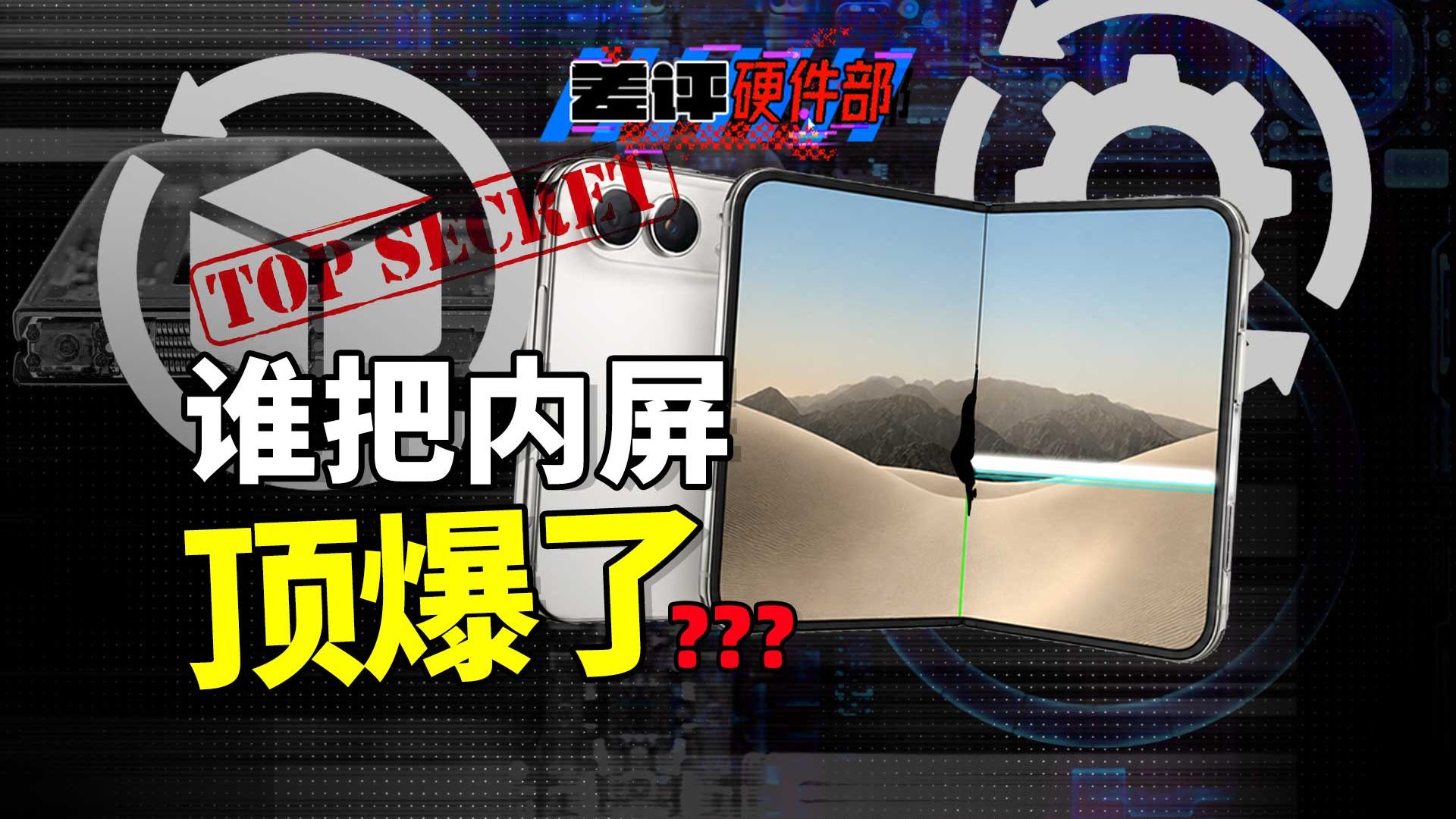
[00:00:00] Users who bought the iPhone Duo in the first batch are having a terrible time.
[00:00:03] But what is actually causing these malfunctions?
[00:00:05] Under what conditions are failures most likely to occur?
[00:00:07] How should users handle the device in daily use to keep this foldable from being damaged?
[00:00:11] We also spoke with a friend familiar with Apple's supply chain [00:00:13] and obtained some information beyond what has been publicly reported.
[00:00:22] To understand the iPhone Duo's malfunctions, [00:00:24] we first need to look at the symptoms in order to prescribe the right remedy.
[00:00:26] But what if we put all these failure photos together and look at them as a whole? [00:00:29] You'll notice that the damage locations are surprisingly consistent. [00:00:31] Basically, they're all cracks or leaks in the folding zone in the middle of the inner screen, [00:00:35] accompanied by a clearly visible bright line. [00:00:37] Some users also mentioned that their phone was working perfectly fine, [00:00:40] but then at one point when they unfolded it, [00:00:41] the hinge suddenly became stiff, [00:00:42] followed immediately by an odd noise, [00:00:43] and then the screen went wrong. [00:00:44] Other users, whose inner screens hadn't broken yet, [00:00:46] could already see a noticeable bulge forming at the fold, [00:00:50] as if the hinge underneath was pushing up against it— [00:00:52] unsettling just to look at. [00:00:53] So all the signs point to some structure in the middle section of the hinge. [00:00:57] Following this thread, [00:00:58] we found that three teardowns by other parties [00:00:59] all confirmed our hypothesis. [00:01:00] For example, a CT scan by the international teardown firm iFixit showed [00:01:04] that the positions where the cracks and bright lines converge [00:01:06] are right near a rather complex structure in the middle of the hinge. [00:01:09] Normally, when the phone folds closed, [00:01:11] this part should move downward to make room for the screen. [00:01:13] But what if it doesn't retract fully? [00:01:15] Then when the screen folds, [00:01:16] it could press directly on top of it. [00:01:18] The pressure that should be evenly distributed [00:01:20] would suddenly all be concentrated on one small spot. [00:01:22] The cracks and bright lines mentioned earlier could well have originated this way. [00:01:25] The curved guide rails beside it are also suspects— [00:01:26] if they get stuck when the phone is opened, [00:01:28] that could likewise interfere with the screen's normal bending. [00:01:30] Even more coincidentally, [00:01:31] another YouTuber, [00:01:32] Curious Hagi, [00:01:33] also broke the inner screen while doing durability testing on the iPhone Duo. [00:01:36] When he opened up the hinge to take a look—well, what a surprise: [00:01:38] a metal linkage in the middle had actually snapped. [00:01:41] And the location of this linkage [00:01:42] was almost exactly the same as the suspicious area [00:01:45] iFixit had previously identified. [00:01:46] It is itself thinner than the adjacent parts above and below it, [00:01:49] and there's a small notch at the fracture point. [00:01:50] On the screen support plate next to it, [00:01:52] you can also see marks left by the part being squeezed at some point. [00:01:55] The domestic blogger Gao Cuo Ke also analyzed the hinge [00:01:57] and found that the part corresponding to the fracture location [00:01:59] is likely a structural reinforcement piece added later to increase the hinge's strength. [00:02:03] If this reinforcement piece itself fractures, [00:02:05] its edge would indeed pierce upward through the screen from below like a needle. [00:02:09] Wow— [00:02:09] now the hinge's suspicion has grown even stronger. [00:02:12] Beyond the support structures, [00:02:13] some people online also suspect dust intrusion. [00:02:15] iFixit's powder experiment also found [00:02:17] that some powder could enter the hinge's moving area, [00:02:19] causing odd noises when opening and closing. [00:02:20] However, [00:02:21] this only shows [00:02:22] that the hinge could be affected after dust gets in— [00:02:24] it doesn't prove that the broken screens of first-batch users [00:02:25] were caused by dust. [00:02:27] Additionally, [00:02:28] after communicating with the supply chain over the past couple of days, [00:02:29] we discovered another possibility. [00:02:31] Apple's hinge body this time is made of 3D-printed titanium alloy, [00:02:33] but the broken part on it [00:02:35] was made using a process called [00:02:36] metal injection molding. [00:02:38] If there are quality control problems during the sintering process, [00:02:41] the strength of the structural piece could be compromised. [00:02:43] For example, the iPhone Duo we have on hand [00:02:45] has been used for over ten days [00:02:46] without any issues, [00:02:46] but some bloggers' units broke after just three or four days, [00:02:48] or even within a few hours. [00:02:50] So it's very likely that the hinge design itself is fine, [00:02:52] but the strength of this metal part on individual units is problematic. [00:02:56] However, to verify this theory, [00:02:57] you'd need to perform industrial-grade X-ray inspection [00:02:59] on at least a hundred or more hinges— [00:03:01] that's not something we can do. [00:03:02] It would have to be Apple working together with its contract manufacturer to inspect the incoming parts. [00:03:06] And even if results came out, [00:03:07] we might never know about them. [00:03:08] For example, the iPhone 6 Plus previously had the "white line on screen" issue, [00:03:11] and the cause was found to be occasional cold solder joints on the screen IC. [00:03:14] Although Apple never publicly announced the cause of the failure, [00:03:16] the second batch of iPhone 6 Plus units immediately had a ring of glue [00:03:19] applied around the touch IC. [00:03:20
] So if you really like the iPhone Duo [00:03:23] and have the purchasing power, [00:03:24] but you're worried that one day it might suddenly develop a problem [00:03:26] and catch you off guard, [00:03:27] you could actually wait for the batches [00:03:29] produced later in December or January. [00:03:30] That said, those who bought the first batch of the iPhone Duo [00:03:33] don't need to panic. [00:03:33] We got in touch with Apple, [00:03:35] and Apple has responded to consumers through us. [00:03:37] To sum it up in one sentence: [00:03:38] if there's a fault, you can get it replaced. [00:03:40] That attitude is fine, [00:03:41] but the problem is that no one knows [00:03:43] when the fault might appear. [00:03:44] If it breaks within the warranty period, that's one thing, [00:03:46] but what if the problem only shows up after a year or two, once the warranty has expired? [00:03:49] Would users really have to pay out of their own pockets to fix the screen? [00:03:51] Come to think of it, this isn't the first time Apple has faced a similar situation. [00:03:54] For quality issues affecting certain models or batches, [00:03:57] Apple has launched dedicated free repair or replacement programs. [00:04:00] Eligible devices could be handled even after the standard warranty period had expired. [00:04:03] So this issue surfacing early is actually a wake-up call for Apple. [00:04:07] Right now, beyond quickly investigating the cause of the fault and determining the scope of its impact, [00:04:10] what's more important is giving users a clear, definitive after-sales solution, [00:04:13] so that first-batch buyers can use their devices without worry.