
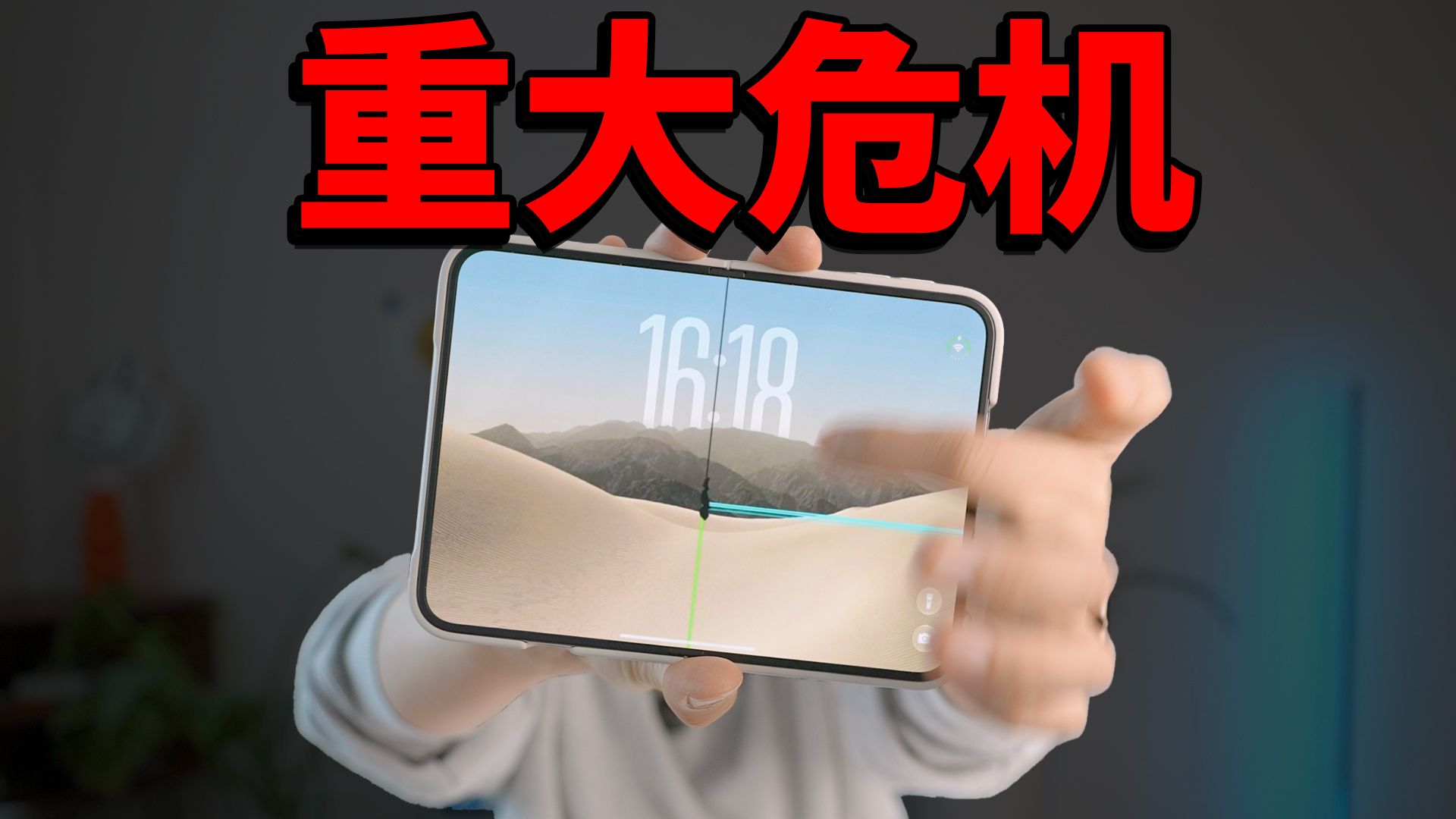
Recently, a lot of friends have been asking me: did your iPhone Fold's screen crack? That's impossible—mine didn't crack. But I did look into it, and many users around the world, iPhone Fold users from all over, have reported this cracked screen problem. And the biggest characteristic is that the crack locations are all pretty much the same. Another issue is a bulging problem in the hinge part in the middle of the screen. I watched a Korean YouTuber whose brand-new machine, right out of the box during unboxing, already had the bulging problem. So I did some research.
I found that all these users had a similar usage history, and it goes like this: when using it normally, everything is fine, no problems at all. But then suddenly, when unfolding it, they feel the hinge is a bit stiff—uncomfortable—and they wonder what's going on. So they keep bending it, and while bending, there's a very tight feeling, then crack—a thud—and the screen shatters. That's the effect that appears: this area just snaps and breaks, and on this side the LCD cracks, creating this laser-like effect. So I looked at the internal structure of the iPhone Fold's body.
The breaking point is in this area, and for most users it's in this area—the flex cable, the part below it. Then I looked at Korean YouTube. This YouTuber is called... gumi curia hag or something like that. Like JerryRigEverything, he does extreme tests, rubbing sand and things like that into it, and he perfectly reproduced this problem. He first bent the screen backward forcefully, and after bending it backward, he then bent it normally, and at the moment of that bend—
crack—a loud snap, a thud—and the screen showed the same symptom: it shattered. Then when he disassembled it, he found that this part—this is the flex cable we just saw—below this flex cable, this part had broken. And on the back of the screen, there were impact marks after the break: this part of the hinge structure, when the screen broke and rebounded, whipped back and smashed the underside of the screen, so the screen cracked exactly at this spot. So he perfectly reproduced the problem. You can see this part is broken right here.
But what I'm personally very curious about is why the left side has no problem. This part is worth studying—worth Apple investigating internally. Also, regarding the broken hinge part, when he opened it up, he found there was no foreign matter inside. He had previously stuffed sand and other things inside, and those other parts did have debris, but this problem area, this broken part of the hinge structure, had no sand or other foreign objects inside. So it wasn't a case of sand getting in and causing this structure to malfunction.
And then striking the screen and causing it to shatter—it shouldn't be that problem. So after this structure breaks, it looks like this. You can see it's separated. Its structure is slightly different, because this part is slightly recessed and thinner. The normal thickness is this thick, but this part, because of the recessed structure, is a bit thinner. So physically, its overall rigidity is lower than this side's, and it was exactly this very thin part that broke. In Korea, there's an Apple iPhone Fold supplier called FM Tech, and that company's stock price plummeted—
it dropped straight down by 15.7%. But they immediately issued a statement, because once the stock fell so badly, they put out a statement saying that the hinges they produce have no problems and meet requirements. But when I checked again today, that announcement had already disappeared. Possibly they looked internally and realized the legal wording might need adjusting and refining, so they temporarily took it down, or something like that. In any case, the announcement can no longer be seen. And here we can see something very interesting about human society.
Why are we modern humans so unhappy? Look at this: FM Tech, after the iPhone Fold went on sale on October 23rd, saw its stock price jump 10.29% right away. Internally they must have been thrilled—"Awesome, we landed a huge order, the stock is soaring!" But just two days later, after the screen-cracking controversy emerged on October 26th, it plummeted 15.7%. This is why people today are unhappy: you can't fully enjoy yourself. Unlike in ancient times—when there was a great harvest, or when someone in the village got married, everyone would celebrate together, singing, dancing, drinking, having a great time.
But not anymore. Isn't this bloody proof? On launch day the stock rose 10.29%, but you can't celebrate freely, because you don't know what problem might pop up tomorrow or two days later. But I looked into it, and it seems FM Tech is probably not the manufacturer of this particular component—there should be another company. In any case, the screen-cracking problem definitely exists, and the Fold officially acknowledged it—on October 26th it formally admitted that a small number of devices have an inner screen issue, and told those users to contact AppleCare or the Genius Bar.
But this time Apple did not disclose the specific number of affected units or the cause, and it hasn't issued a recall either, so we'll need to keep following this. Still, I have great confidence in Apple's after-sales service. Having lived in Korea for so many years, I feel the best after-sales service comes from Apple and Samsung. Others, like LG, use third-party outsourced service in the Korean market—when you call, the customer service reps act like they're going to war, like robots, basically fighting against you. But Apple's after-sales service is like... it has a screen issue.
After wiping it with alcohol, the screen gets cloudy. Even though the warranty expired many years ago, Apple still replaced it for us for free. I actually had the MacBook screen replaced back then. Another example is the AirPods. My AirPods happened to have the problem that Apple officially acknowledged, so I went to the Apple Store and found a Genius at the Genius Bar, and he replaced them for me on the spot. I even recorded a video of it at the time, which you can refer to. A lot of friends have said that after watching my video, they went to the Genius Bar and got theirs replaced right away.
Because Apple itself acknowledges these problems, they will still replace them for us even after the warranty period has expired. This kind of experience, which I have personally had, is really quite good, so I have quite a lot of confidence in Apple's after-sales service. Another point is that this iPhone has an IP68 rating. I've shared this in many previous videos: personally, I'm very satisfied with this IP68 rating. The previous Z Fold 8 had an IP4X dust rating, while the dust resistance rating of the iPhone Fold is the same as the Fold 8's.
But the iPhone Fold can withstand 6 meters of water depth for 30 minutes, while the Z Fold 8 can withstand 1 meter of water depth for 30 minutes. In short, both of their water resistance ratings are level 8, but the iPhone Fold's official claims are better, so it may be more durable. As for the dust resistance rating, honestly, I was personally quite surprised. Reaching IP68 means its overall dust resistance should be a bit stronger than the Z Fold 8's. Looking at JerryRigEverything's test—although his methods are a bit extreme, stuffing sand and things like that into it—the hinge area still had a large amount of sand get inside, and when the sand got stuck in the middle of the hinge, there was a crunching, grinding noise. So I was quite surprised at the time, and then I did some research. It turns out that the IP68 rating's dust resistance mainly refers to dust—it doesn't mean it can keep out sand. But I was curious why it can resist dust but not sand. After looking into it, I found that the dust resistance ratings these foldable phone makers achieve refer to protecting the sealed areas; they do not include the mechanical structures—the exposed mechanical structures are not covered. So if we actually look at the dust tests that iFixit has done, the iPhone Fold's dust resistance is indeed a bit stronger than the Fold 8's. Most of the dust gets concentrated in the hinge area, while the amount of dust entering from both sides of the device is still much smaller. In short, the hinge is not included in the IP68 rating.
The next question directly concerns every one of us: the repair price. I took a look, and the inner screen repair price is exactly 999 US dollars. As for the hinge, it may indeed have problems—we have to admit that when you bend it like this, it can shatter the inner screen directly. This really has a big impact on users. So given such a high repair price, here's my advice: first, you must buy AppleCare+. Another purchasing suggestion: if you absolutely must experience the iPhone Fold the moment it comes out, then you can also buy AppleCare+. That way you can completely buy the iPhone Fold—you can be a user who can bear these risks. But if you buy an iPhone Fold and want to keep using it for three to five years, and you often work in sandy or dusty environments where the device is frequently exposed, then I'd recommend waiting and watching for now. During this period, you can observe whether Apple expands its official service coverage—keep an eye on that. But if you're really impatient, just buying AppleCare+ can solve all of these problems.
As for the brand-new form factor of the iPhone Fold, I've personally been very satisfied using it. I just couldn't wait to use it. So, once you've got it in hand, what should you do? After getting it, you must do a check right away. When you power it on, don't fold it back and forth like this—even I got a little scared folding it suddenly like that. Fold it slowly, and listen for any strange noises. Record a video while testing, so that Apple will believe you too. Then check the hinge in the middle for any bulging—normally there should be none at all. And the most important thing: while using it, you must keep this hinge area clean. Apple's official website also says to check whether there's any foreign object there before unfolding.
Also, when you fold it, don't just fold it directly—check whether there are keys, coins, or any hard objects. Check the middle of the screen, and then slowly fold it closed. One more thing: during use, if you suddenly find that the hinge has become tighter—it feels a bit stiff, and you wonder what's going on, and it's a bit hard to fold—do not use brute force to force it closed. If you force it, the screen will definitely shatter with a crack. If something feels off, stop immediately, take the iPhone Fold straight to the Genius Bar, and let them take a look—that way Apple can rest easy too, thinking this person isn't lying. Then the Genius will take a look, Apple internally will check it, and if there really is a problem, they will very likely repair it for us for free, or simply replace it—just swap the whole unit.
As for the issue of the iPhone Fold's screen cracking, I'll personally keep following it. There really is a slight sound—I'll test it. The iPhone 17 Pro Max also makes sounds; they all have a slight mechanical-structure rotation noise. This one has it too, and so does the Fold 8—but this Fold 8 is really light. In any case, with the iPhone Fold, you absolutely must buy AppleCare+.