
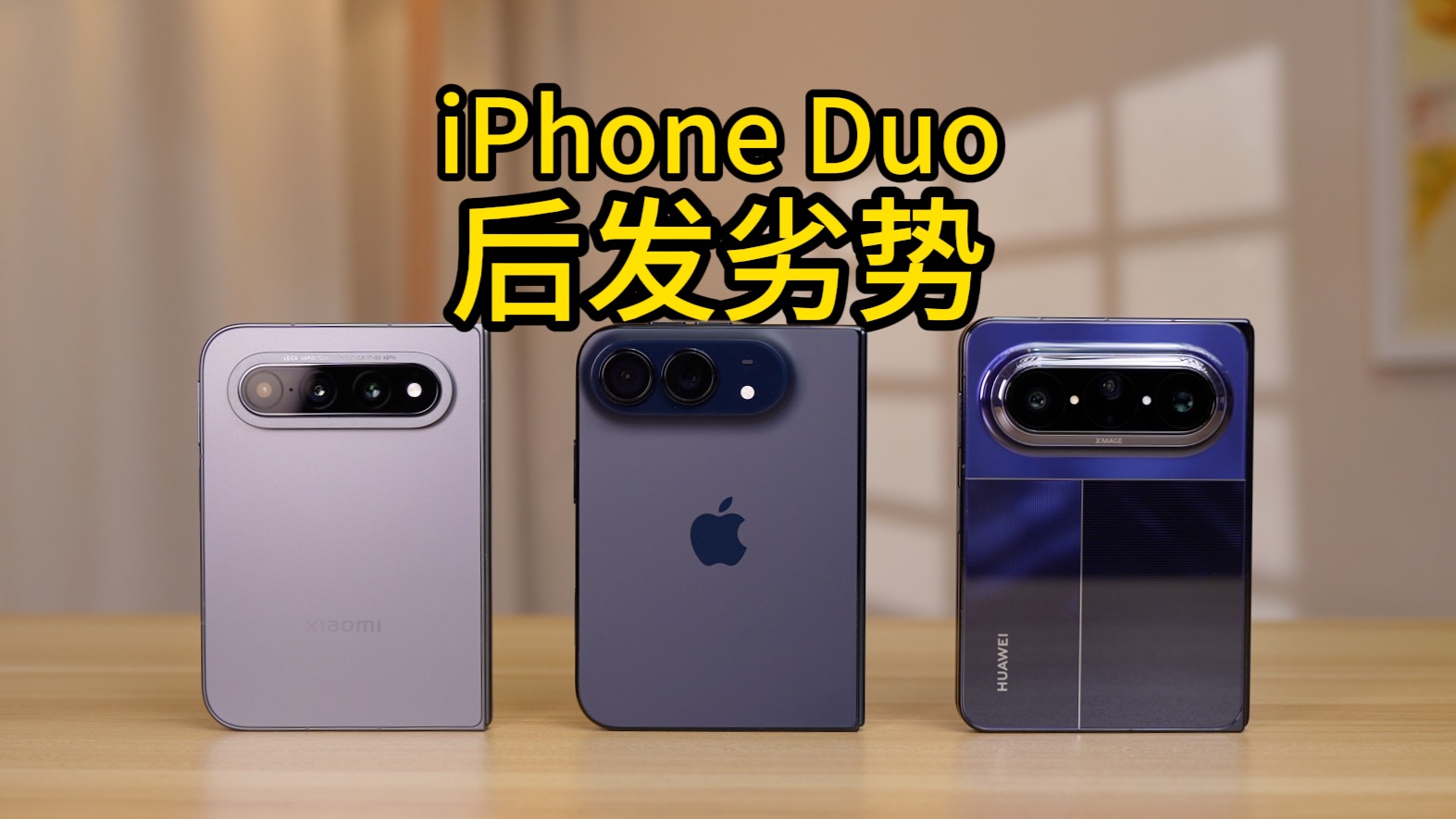
The iPhone Fold simply isn't worth over 10,000 yuan. If Android or HarmonyOS dared to release such a half-finished product right now, their executives would get flamed off the internet. Apple clearly could have just grabbed your money, but it still gave you a foldable screen—what more do you want? So what if the software adaptation is half-done? One day it will be adapted, and when it is, you'll find out what "cruelty" really means. Then why don't you wait until that adaptation day to charge me, right? Or have developers adapt in advance before the launch, right?
I've been using this phone intensively for a few days. I actually switched my main SIM card to eSIM to use it—it's not like I'm running it without any card at all. I'm telling you as a blogger who uses it in depth.
Let me just give you my conclusion right away: at this point, it's really just a few-thousand-yuan-level device. Bugs everywhere, logic is a mess, apps are basically unadapted, and the hinge might still have issues. The foldables from Huawei, Xiaomi, OPPO, vivo, and Honor currently crush the iPhone in overall experience. After using the iPhone Fold, I take back what I said before about Xiaomi's small foldable being a bit too loud—I apologize. Of course, I'm definitely not clickbaiting; you can judge the rest of the content for yourselves and see whether I'm exaggerating. Before the video starts, I'm still asking for a like, coin, favorite, and follow—this really matters for me to independently speak the truth. Thank you all.
In terms of design and dimensions, this phone is nothing new anymore, right? It's similar to Huawei's and Xiaomi's. The wide screen is also a root-two-to-one ratio. Like Xiaomi, its exterior is made into a D-shape, so when you unfold it, it becomes a small tablet with large rounded corners. Huawei didn't go with large rounded corners, so on its outer screen the corner radii are uniform. As for the iPhone Fold, let me start with the pros after using it. First is the build quality: glass body plus titanium frame, the whole device looks very premium. The camera module is placed horizontally and uses a one-piece cold-engraving process. Overall, the design is minimalist and easy on the eyes. Of course, I prefer the white one—I just couldn't get it.
Second is its crease performance. I've been using it for a few days, and as you can see, with the screen off, the crease is indeed very visible. But Apple cleverly applied a 398-yuan premium matte film on the inner screen, right? That gives it strong anti-reflection capability, and it looks great once the screen is on. Also, Apple's hinge gives you a spring-assisted push when it's about to fully open—you don't need much force, and it opens perfectly flat. With Xiaomi's and Huawei's foldables, as you can see when I unfold them, there isn't that much force—you need to bend it outward a bit for it to go fully flat. Many times, if you don't give it that push, the inner angle isn't a complete 180 degrees. The creases on Android and HarmonyOS foldables are more noticeable. Based on these two points, after the screen lights up, the iPhone's front-facing viewing experience does have a weaker perceived crease. Of course, there are trade-offs: with the matte finish, when you view the screen slightly from the side, or under strong light, the contrast clearly drops and there's obvious whitening. And Apple's so-called nano-texture layer is just a film—it's been confirmed to be peelable. It looks like a film, feels like a film, and behaves like a film, and it's not integrated with the screen. If it's not a film, what is it? You can only say it's a slightly more expensive, higher-quality matte film. Apple really pulled a sneaky one this time.
Also, I tested the middle area of the inner screen near the hinge—it's genuinely soft there. You can feel a noticeable give when you touch it. Although both sides are rigid, the middle feels very insecure. In this condition, how would I dare use an Apple Pencil? On Huawei's and Xiaomi's, the middle doesn't have this issue. And stains on the inner screen are hard to clean—sometimes you can't wipe some stains off with a cloth and need screen cleaner.
Third point: battery life. This phone's battery life is strong. Don't be fooled by its modest battery capacity—casual use easily lasts a day. With my heavy app usage on 5G and Wi-Fi 6 mixed, it ended up with over nine hours of screen-on time. I basically have no battery anxiety using it, which is a very good level.
Fourth point: the peripheral hardware is also good. Four-microphone array, four ambient light sensors—in daily use, auto brightness performs very well. Big haptic motor, water resistance, all included. As for the speakers, although they're not symmetric top and bottom, the external sound quality is still decent. As for the fingerprint hardware, there's nothing to be done—all current foldables are like this; you can't single out Apple for using a side-mounted fingerprint reader, right? But its software unlock experience is bad. The biggest problem is that it can't unlock with the screen off—you either raise-to-wake or press to light it up. Second, even after unlocking, as you can see here, there's a process of clearing and entering the home screen, or it's waiting for you to swipe, right? It's indeed anti-accidental-touch, but that's face-recognition logic—it feels weird applied to a fingerprint reader, and the animation is very sluggish.
So with the pros above, you might think, hey, it's decent, right? For a foldable: build quality, crease, battery life, and specs are all good, and the animations are beautiful. Look how logical this folding animation is, how smooth the Dynamic Island is. If you don't hype up this animation at launch, Apple might not even reimburse your flight ticket. But back to the beginning—why do I say it's not worth over 10,000 yuan? Even though this is Apple's first foldable, the foldable category has existed since 2019, right? If you can't lead, at least be on par with your competitors. Next, please allow me to walk you through, in detail, the splendor of Apple's foldable that launch reviews won't tell you about. Extreme Apple fans can click away now.
Let's first look at Apple's own app adaptation. During activation, I was shocked—its own foldable, its own system, why can't it fill the entire screen? Then I opened the camera and I was so angry I laughed. This bug really got me—it wasn't my camera; the camera went transparent and disappeared. Okay, update the system to the latest version. The large-screen camera is made especially cheaply—even the text on the right, they couldn't be bothered to rotate it. Compare that with Android's and HarmonyOS's cameras. Is this a third-party problem? Sometimes the Photos app also bugs out and doesn't display fully. The lock screen interface
A bug that triggers 100% of the time, folks. Oh look, it just became rounded corners. Oh, now it's turned into a Huawei P2x Max. If this isn't a half-finished product, what is? Right when I was about to wrap up filming, the camera had another bug. Let me show everyone again — there's yet another bug, right? Look, the photo album is useless now. When we normally record a video, there's this black area in here. Compromises everywhere. And a lot of the whitewashing bros say software adaptation is a third-party problem. Well then, look at Apple's own App Store. When you can't even make yourself presentable, do you really need third parties to make you look good? This phone went on sale on the 23rd, and today it's already been a week.
If even your own first-party software isn't adapted, do you all think this money was well spent? And right now, apps with no adaptation at all are still the majority. Xigua Video isn't adapted. RAW isn't adapted. Not adapted, not adapted, not adapted, not adapted, not adapted, not adapted. Zhuanzhuan isn't adapted. Meituan, right? It even drops frames. WPS is adapted — well, that's shared-area stuff too, that's tablet adaptation. Not adapted, not adapted, not adapted. Oh, Jufeng Camera is adapted — the teleprompter. Oh, the teleprompter. Mom, what's going on? See, no animation, right? No animation. The slider isn't adapted. Prove Movie isn't adapted. Oh,
it can even let you zoom in. Oh, and I found that with the camera — ah, this way the camera is upright. See, this way the camera is rotated 90 degrees. Not adapted. Including, including Beike Zhaofang — not adapted. Pinduoduo isn't adapted. You could say that many of the apps I use daily aren't adapted. When you unfold this big screen, the displayed content isn't even as good as a small iPhone. When switching between landscape and portrait, many apps are a total mess. And right now you can't even play games properly or comfortably. Now let's talk about the partially adapted ones — the half-adapted apps. These apps have basically just slapped on iPad logic. CapCut (Jianying),
right? Isn't this just a tablet? The right side is completely a black bar. The national app, WeChat — it can indeed log in as a tablet now. But look at this little black bar on the right side. When folded, it's WeChat Moments — the cover image at the top got directly distorted, and even my watermark got pushed out. Then look at this ring around the bottom — huge black bars on the left and right sides. Isn't this shared area way too big? And the font is very small too. This is clearly phone adaptation. Now let's look at HarmonyOS's adaptation. With HarmonyOS, for some longer content, it can extend over to the right. Now let's talk about the adapted apps.
Apps like QQ Music, iQIYI, and Weibo — these are the ones I think are adapted pretty well. QQ Music has a dedicated album cover at the bottom. After folding iQIYI, there's a control panel at the bottom. As for the ones previously said to have good foldable adaptation, Bilibili comes first. At first glance it looks great, right? The sidebar is there. But its logic is extremely chaotic. The right side has been adapted — see, it's adapted very well, right? Then you tap into "Mine" — oh, that's nice too. The second-level interface looks decent. But once you get to the third-level interface, you'll find the sidebar is gone. And some buttons get blocked. For example, this one here — sometimes you just can't tap it. Then entering the third-level interface, its sidebar comes back, but at this point it has no function at all. Then in this interface the sidebar is gone again, and the inbox at the top is blocked. And often there's no back button — you can't go back, and you can only use the most ancient top-left back button. Side-swipe doesn't work either. Sometimes Settings and Messages also get blocked. When you unfold from the outer screen to the inner screen, the content refreshes. Sometimes you've picked a piece of content on the outer screen — oh, let's unfold and take a look — oh, it's gone. Switching between landscape and portrait also refreshes the content. When you open a portrait-orientation video on the outer screen,
then unfold it, you'll find — oh, why can't it go landscape? The probability of this is very high. Those of you with the device can try it yourselves. And display bugs like this happen all the time, bros. I've only been using it for a few days and I've found this many problems. JD and Taobao count as fairly well adapted — they both have sidebars. The first-level interface is great, right? Then tap into the second-level interface — look at the bottom and right-side bars. Look at this shared area. Especially on the outer screen — when you use it, excluding the sidebar, the lower-left portion of displayed content is very small. It's true that its aspect ratio is closer to a slab phone and displays more content, but the text and images are smaller.
So what's the point of the wider screen then? On Tencent Video, the truly effective display area on the outer screen is just this little bit. This shared area really reminds me of the Xiaomi MIX Flip's outer screen — it completely fails to show off the wider display. Speaking of shared areas, look at Xiaohongshu (RED) and Coolapk. They've also done sidebar adaptation, but this shared area is almost as big as a tube-shaped apartment building. Swipe this video up and you'll find — oh, this shared area is really huge. Sometimes the buttons in the top right corner — see this Follow button — it gets blocked too, and sometimes you just can't tap it. And there are problems that exist on both Android and HarmonyOS, like images not fully displayed after unfolding,
second- and third-level interfaces just being mindlessly enlarged, and the adapted sidebar disappearing. WeChat mini-programs are hard to use. These existing Android and HarmonyOS problems, Apple has copied over for you completely unchanged. And there are bugs everywhere. Seriously, I've only used it for a few days and bugs are flying all over the place. In this iPhone Fold experience there are many more problems. Including, look, this anti-human volume button — it's on the top. Is putting it up there really convenient? Sometimes you want to press the volume and — bam — you press the lock button on the right side instead. When Huawei made foldables, it already taught you how to do the volume button, right?
Apple, you can't even copy the answer correctly. And this sidebar has another problem: it can only be operated with the right hand. Doesn't HarmonyOS have that grip posture feature? Honestly, I think Apple should consider copying that grip posture feature — recognizing left or right hand. Wouldn't that be better? With the iPhone Fold, when you unfold it to use it, going back is extremely difficult. But Android and HarmonyOS have side-swipe back. Sometimes we just want to scroll through a feed, right? No complicated operations — just scroll a bit, then side-swipe back. No problem — Android can handle that completely. But with Apple, tapping that back button is a real struggle.
One careless moment and your phone could end up at the service center. So, after using the iPhone Fold for a few days, I can say: lots of bugs, confusing logic, and most apps aren't adapted for it. It's a half-finished product. For a premium brand like Apple, this is a huge blow to its image. Everyone, including me, had really high expectations for Apple's foldable. That's why, before the launch, people were predicting a premium markup of thousands of yuan, and JD even ran a 7,999 yuan lottery for a chance to buy one. With this release, Apple has truly fallen from its pedestal. To protect production capacity, it has loosened quality control—product experience is no longer Apple's top priority.
I really can't believe this product was made by Apple. Are you sure the software wasn't outsourced? And as I just said, foldable screens have been around for seven or eight years, yet the hinge design still has obvious flaws. Many users have already reported problems with the inner screen, and basically all in the same spot. What's funny about the affected units is that the back looks way too much like the P2x Max. Apple hasn't denied the screen issue either—it even issued a statement saying, if you have a problem, go to AppleCare. Beyond that, its overall camera capability is mediocre. The main camera and ultra-wide are okay.
But there's no telephoto lens. If you want to shoot distant scenes, it simply can't handle it. Other foldables in the same category—Xiaomi and Huawei—both have telephoto lenses. Why doesn't Apple? It's heavier than the competition, the battery is smaller, and it weighs over 250 grams—surely you could have managed a telephoto lens? The funniest part is the periscope camera on the inner screen—it's like going back ten years. Look at the oil-painting feel of these photos. And then look at the video: my indoor lighting isn't even that bad, and this image quality genuinely made me laugh. The front camera on the outer screen is also very mediocre. So the cameras really don't live up to a starting price of 16,000 yuan. This phone has another problem: heat. Thermal control is terrible.
Sometimes just scrolling through videos or playing music makes the back heat up. Outdoors, even without any heavy usage—just browsing Weibo or chatting on WeChat—the phone is often warm. And I haven't even opened the camera yet. Seriously, sometimes it heats up for no reason at all. Besides the heat, smoothness is also an issue. The iPhone Fold still has lots of small frame drops and stutters. Just casually opening an app causes frame drops. When scrolling through feeds, many apps stutter and lag along the way. It doesn't hold a candle to the iPhone 18 Pro—not even close. Using this as your daily driver will drive you absolutely crazy.
So, having watched this far, you can see I'm not clickbaiting. This thing genuinely doesn't deserve to sell for over 10,000 yuan. Charging a high price is fine, but you have to deliver matching quality. The iPhone 18 Pro and 18 Pro Max are excellent, so their high sales are well deserved. But this generation of the iPhone Fold, at least this generation, is a piece of crap—completely unpolished, a piece of crap with no caveats. I think its fate will be just like the iPhone Air's: a dramatic price plunge. Because rich people are rich, not stupid. What would you even do with this thing? App adaptation is poor, the hinge is poor, and it doesn't even work as social currency. Adaptation won't come until April next year, but I've already paid my money upfront, right? That's exactly why I made this video early—I predicted the price would crash, so I need to sell it quickly, or I could lose several thousand yuan later. For those of you who want to buy it, I suggest waiting for the second generation, or waiting until next year to see how the app adaptation goes before deciding. Don't waste your money right now. OK, that's all for this video. If it helped, please like, drop a coin, and follow to support me—that's the biggest motivation for me to buy phones with my own money and tell the truth. I'm Gold Medal Teacher Zhu.
See you in the next video. Bye-bye.