
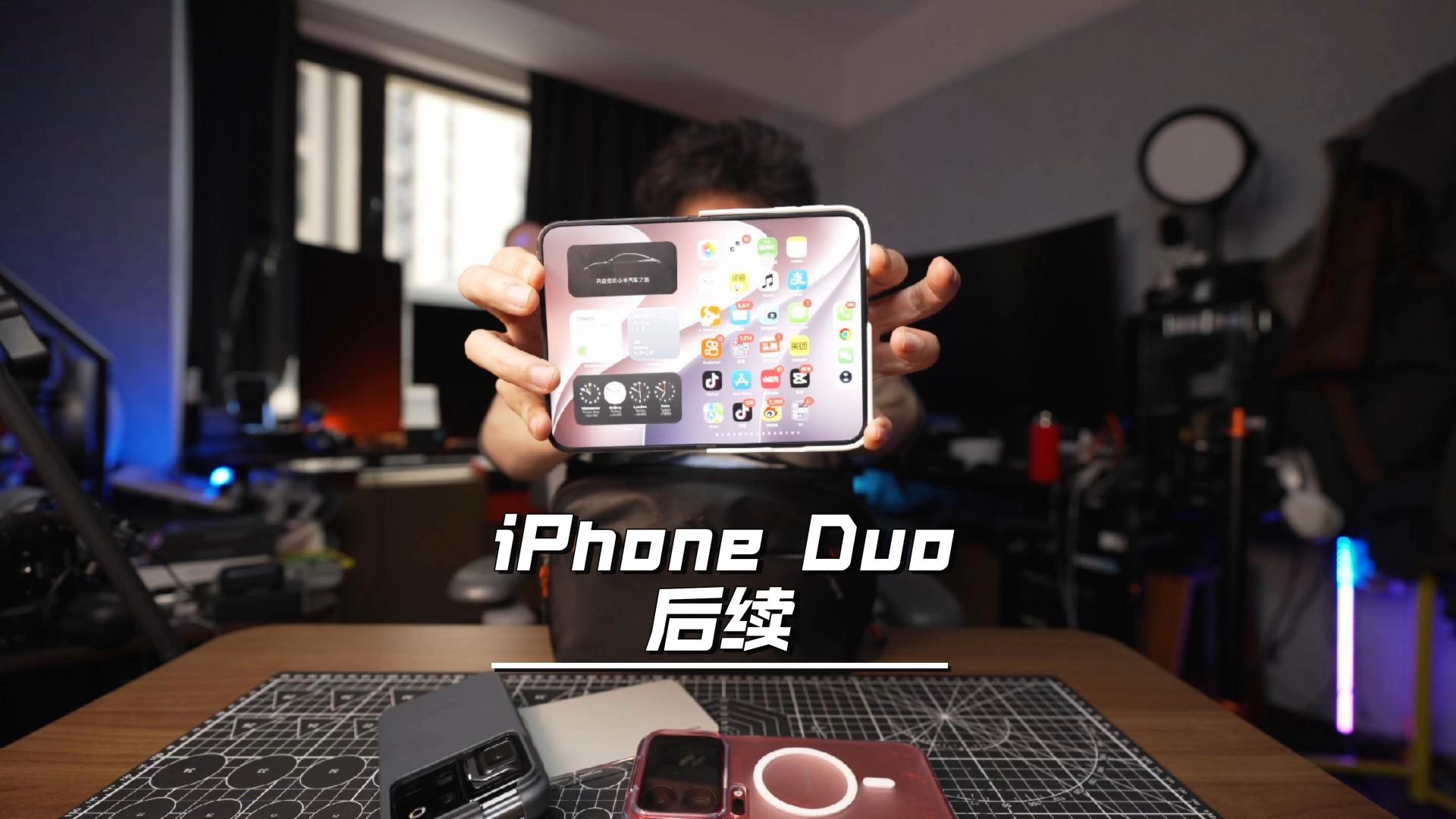
About the iPhone Fold — my previous video was already the final version, it was over. But during my livestream, a lot of people asked me what happened. Everyone, take a look — I already explained it in my video. Let me emphasize: I genuinely believe the iPhone Fold should never have had this kind of quality problem. In that video, I first said this thing shouldn't have happened in the first place — how could it break? Then later I added a plot twist. The video you just watched was recorded yesterday and edited yesterday. This morning I had just finished my big livestream session when I got a phone call — and this is the follow-up. Finally, I can use a new unit again.
But apparently nobody stuck around to the end. So yes, correct — within three days of my iPhone Fold breaking, Apple had already repaired it, or rather replaced it with a new unit, and I've already received it. So in this video, let's talk about its pros and cons afterward, including how it holds up after being used for this long. Mm-hmm, right. Where is it? Is it here? Oh, oh — it seems like it's not this iPhone. Ah, here it is, found it. This is my iPhone Fold, and I've been using it for quite a while now, friends. And no, it has not broken — as of today, it hasn't broken. So this video can give everyone a summary.
Look, I even put a case on it, which shows I'm really using it seriously. From day one, from the moment I bought it, I intended to use it very, very seriously. I later even bought two cases for it that I wanted to try out. I was genuinely, seriously trying to use it. So after all this time, what's the follow-up? Last time I hadn't finished — those were the terrible designs — and this time I'm completing the picture. That's right, the iPhone Fold still has a lot of really, really terrible hardware designs. If you haven't seen the previous video, you can go back and watch my earlier one — the one about the screen cracking.
That video covered roughly half of the downsides, I'd say. This time, after all this time — today is November 15, 2026 — it's been almost a month since I got the unit. So how far has the software adaptation actually come? Let's take a look together. A very, very regrettable thing is that WeChat still hasn't been fully adapted to this day — it's only half adapted. Google's app, Gemini, also hasn't been fully adapted. That's right — probably because they're Apple's competitors and don't really like doing compatibility work for a rival. And my own big platform, Douyin (TikTok), is still like this to this day, which pains me a lot. In the past, a lot of software adaptation did get done.
For example, part of WeChat has been adapted, and I've seen many other apps starting to adapt too, including many other platforms that adapted right away. But I don't know why Douyin, Google, and some of WeChat's top apps still haven't been adapted to this day. I don't know whether adaptation takes a long time or what — or maybe they want to do it perfectly. But Apple gave them a window of six months. I think they have room; they haven't done anything wrong. Have they done anything wrong? No, they haven't. Nobody has done anything wrong. Software adaptation is still ongoing, and I believe it will be solved someday in the future.
But the hardware problems are really serious. In the last video, I mentioned that the camera could actually have been a third one, but they didn't do it. And the matte screen here might not be as clear and transparent as it could be. Including the hidden camera — selfies look like a ghost. And it still gets stuck in this spot — that hasn't been solved. But what other hardware shortcomings does it have? Come, everyone, watch me fold my phone — what happens? The two sides of my phone are almost aligned — compared to back then, they're aligned now. Now, here I need to clarify something, and this is the core point of this video: is the iPhone's hinge design necessarily a hardware defect?
Based on this long period of use, and after repeatedly testing after I got the new unit, the answer is: it's indeed as Apple said — the hardware issue was due to a very small number of units having a design/manufacturing problem. So will the screen break after a very long time of use? I can tell everyone with confidence: if you've already gotten a replacement unit, most likely, as long as you don't drop it, with normal use you're unlikely to be as unlucky as I was and have it break. This shows that some suppliers' first batch of shipments did contain hardware faults and defects in certain units. And I just happened to be in that very, very unlucky batch.
I spent time backing up, I spent time sending it back to the factory, I spent a lot of time on all this pointless stuff. And I was really angry — you have to understand, back then it was hard to even buy a unit from the first batch without paying a markup. I paid extra to buy mine. In the end, they replaced it for me, but it was already one of those replacement stock units. For me, I don't know how big the loss was. But it's true that after all this time — since I got it on November 2nd — I've used it and used it for these ten or so days and it hasn't broken, and it works just like before. But let me tell you, the first moment I got it, here's how I used it:
When I picked it up, I would slowly, slowly open it. I really didn't dare to force it open — I really didn't dare to snap it open like that. But now I can, because this unit, once you get it, you can tell right away there's no problem. With my previous unit, the moment I got it, I noticed the line on top wasn't aligned at all. After I took a photo showing it wasn't aligned, when I opened it, it went "crack, crack." But this unit has been opened from the box many times and has never made that cracking sound. So if you're really worried, this video is the plot twist: it really was a fault in a small number of units from the first supply batch, not a design defect.
I believe that for the first batch, before the improvement, well — everyone can rest assured. In the future, for a long time, there probably won't be many cracked screens, because by the time large-scale shipments go out, that batch of victims will probably have all had their units break already. So everyone can relax and go ahead and buy it. As for the screen — these days I've also been putting up with it. In sunlight, as I said — at home under indoor lighting there's really no reflection, and in sunlight there's very little reflection. But when you look at it outdoors, even without reflections, it does have a matte, frosted texture, a slightly hazy, foggy feeling. It's this glass that makes it look...
It seems there's almost no physical crease, and during use it feels especially like a matte texture. But I think this time there's also something worth noting: what you see is indeed what you get when you open it, but you can treat it like a book to read—and if you really can't stand it, you can just fold it back and use it that way, right? That makes things very straightforward. But how do you solve this problem? I don't know about you all—the iPhone Fold, I don't know which designer lost their mind, but after removing the mute switch, they actually added this button, this camera button. Press it once and the camera mode pops up.
Then you can hold the camera like this and press it—it's over here on this side—and click, it takes a photo. Honestly, the appearance of this button is absolutely a disaster. It should never have existed. Let me ask everyone first: since the iPhone got this camera button, I'm telling you, it has caused me enormous trouble in daily use. Invisibly, it gets pressed in my pocket—it opens. One press and it opens, right? Then when we take photos, we normally hold it like this, and the hand accidentally touches this area without noticing, and it inexplicably zooms in on the focus. Later, didn't Apple improve it?
It became that raised design. So Apple, I have just one question: if you actually bought the Fold, and if you're very lucky and the screen didn't crack, isn't this really awkward? Why? Every time we unfold the device, look—isn't this the motion we use every time we open it? We use the most natural way, wanting to fold it open like this. But when you fold it like that, your hand presses on it—the moment you unfold it, you hit this button. Why is this button in this position? This exact spot is where we naturally use our fingers to unfold it.
Yet it appears in this damn place. I simply can't believe it's there. So we're forced to learn to move our fingers to this spot and pry it open like this—and prying it like this makes it very easy for the phone to slip from your hand and drop. So I think this time, because of Apple's camera button placement, I'm telling you, to avoid accidental presses when opening and closing—to avoid accidental touches—I suggest you'd best spend over 2,000 yuan on AppleCare. If you don't buy it, you're done. I'm telling you, it could very well drop. You think dropping it with a case on means nothing will happen? There's a high probability—
the screen could shatter from the impact, because many people have already experienced this. This is a very serious hardware flaw. It should never have existed, but it does. It simply shouldn't exist. There's also another bizarre problem: because this phone doesn't support facial unlock—I've said this before—what kind of trouble does that cause? It's the unlock experience I've used in recent years—if it could do facial unlock... Without Face ID, it can't fully recognize you as a person and unlock. But even after Apple unlocks the phone, when you go to the App Store to download software, you still need to scan your face, still need to use your fingerprint.
The second step still exists. But couldn't there be a way to set it up so that once we've unlocked with the fingerprint this time, after fingerprint unlock there's a simple facial recognition, so that every time we pick up the phone, since it's already been unlocked, we can just lift it up and it unlocks? Samsung can do it. Xiaomi can do it. You didn't do it. So why am I bringing this up? Look at this design—here I'm using a Torras case to demonstrate. Look, everyone—the phone can only fit a case this big, right? In theory, if you want to stand the phone up with such a big screen—
who wouldn't want to stand it up, right? We take this out and want to stand it up. This kind of case that only protects one side can't do full vertical standing, but that's fine. We can do this: easily pick up the phone, turn it vertical, and set it down like this. And I looked at it—hmm, it seems this is the only way to view it. Then we feel, ah, this is so comfortable. But here comes the problem, friends—here comes the problem. If you leave the phone positioned like this for a long time, you have to unlock it every little while. After a while the screen goes dark, and if you're not looking at it, it locks. What happens when it locks? Normally it's fine—a face scan, like on the iPad, and it's done.
But now, because the screen is so big, you don't want others to see your passcode, right? Of course you'll use fingerprint unlock, so you have to lift it up, touch its bottom, unlock it with your finger, then put it back down and keep watching. Then while watching, it accidentally locks again, and you pick up its bottom again and touch its bottom to unlock it again. Lying horizontally, it clunks around and won't stay put; standing vertically, you have to unlock it on its bottom. This design is truly painful in my actual use. And when you can only watch videos this way, the most absurd thing happens: up is volume down, and down is volume up. What the—
hurry, turn it up—no, wrong way. Is there a dummy mode? Press the gun—understand? You have to forever remember, forever remember, that this side lowers the volume and this side raises it. You must always remember how it's oriented, because its buttons are fixed—you have no way to adjust them. So just slowly adapt, everyone. Good luck. Because of its unlock method, I really don't want to keep using it to binge shows. Later, when I went out, besides carrying it, I also brought my Samsung Fold 8. It was already thick and heavy to begin with, and unlocking it was this much of a hassle. Plus, one-handed use is genuinely uncomfortable. First, it has quite a few design flaws. Second, Apple never considered this thickness.
Add the case on top, and its stability, its added thickness, and its weight make it feel very heavy even for us guys. Every time I pull the iPhone Fold out, I genuinely feel it's a brick. It has even become a self-defense weapon for me. I think if one day I suddenly encountered danger and someone was about to stab me with a knife, I could pull it out and beat them to death with it. That's how heavy it is—that sense of heft is truly substantial. Up to now, the screen problem has indeed been solved, but in terms of usability, the rigidity of the hardware makes me feel it will never become my primary phone.
So, to sum up: the iPhone 18 Pro Max—actually, the iPhone Duo—up to this point, in terms of both hardware and software... the software issues can be fixed, but many of the hardware flaws, including its design philosophy, make me feel it's not a phone people should carry around often. It does, in some sense, solve the problem of combining a tablet and a phone into one device, but you lose too much in the process, because it sacrifices two of the most important souls of an iPhone: first, the user experience; second, photography technology and photo quality—it simply doesn't have them. Third, OK, when the tablet part is unfolded, it's neither big enough to be a proper tablet nor small enough to be a convenient phone. It only adds some dimensions to your viewing experience, but in terms of actually improving productivity, it's almost a step backward. So the most efficient device is it—yet it's an awkward thing to use. As for the iPhone Duo, for me personally, its actual day-to-day experience right now has been nothing short of disastrous. But there's another dimension to it: it really is a social calling card. Many people, after seeing the phone, will genuinely think, "Wow, this person has an iPhone Duo—must be rich." And that's not something I hoped to see.
The latest update: over the past few days, when I go out, the iPhone Duo stays at home. I only take this phone and the Samsung Fold 8 with me. This is the real-life experience of an actual tech content creator, because I pursue maximum efficiency and maximum hand feel—and the iPhone Duo, at this moment, simply doesn't give me either. So that's the summary. I hope this video has answered all of your questions, including those from my first video about the iPhone Duo. That's really how it is. I don't know whether people will still place orders. I've heard that the iPhone Duo can now be bought at its normal price. If you want to try it out as an early adopter, I won't stop you, but I do think it's genuinely not a product most people will use—it's something only a minority will own. One reason is the price; the other is the user experience, which honestly makes me incredibly excited for the second generation. So, did Apple win? Apple, you win—because you've truly made me want to buy the second generation. But the Duo is stuck in my hands. Oh well. If something is good, I'll share it; if it's not good, I'll say so too. I'm Mixius. See you in the next video. Bye-bye!