
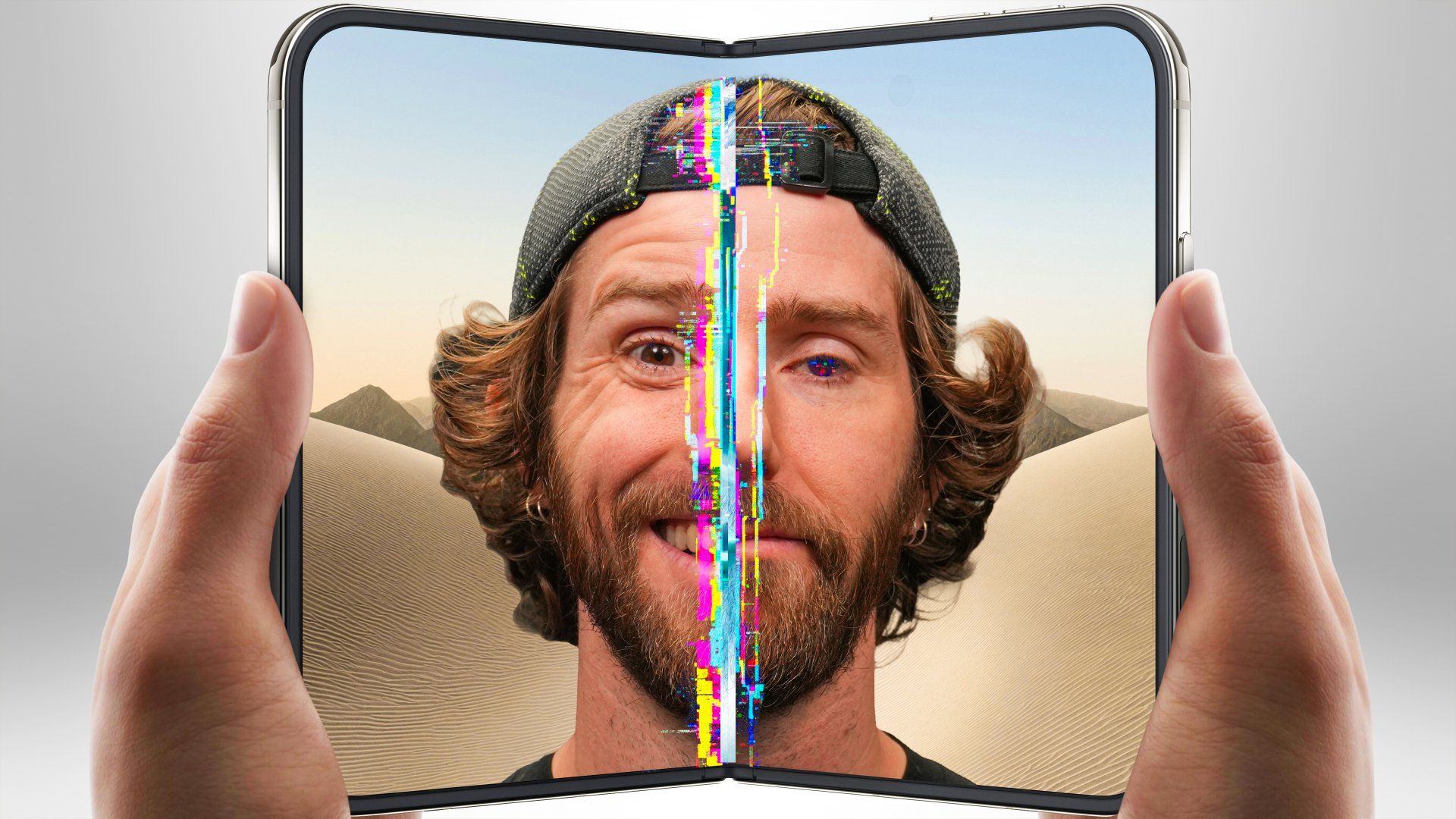
[00:00:00] Now that I have your attention, [00:00:02] fanboys are an absolute plague, [00:00:05] and no launch in recent memory exemplifies this more [00:00:08] than the iPhone Duo. [00:00:10] No, the screen is not unusable, [00:00:13] but it's also not the best thing since sliced bread either. [00:00:18] Like any design decision in a modern device, [00:00:20] what it is is a trade-off, [00:00:22] a compromise based on the best guesses [00:00:25] of the engineers and designers who built it. [00:00:27] And the absolute war that has erupted over this device— [00:00:30] one side of its screen, [00:00:32] a friend of mine from before, [00:00:33] I used to think, [00:00:34] I guess, [00:00:35] I guess, [00:00:36] so, [00:00:37] these last two months, [00:00:38] over here, [00:00:39] I've taken my thinking, [00:00:41] I'll be on one side, [00:00:42] one side, [00:00:43] from the very beginning, [00:00:45] but on the other side, [00:00:46] one side, [00:00:46] yet not always loving them, [00:00:50] so, [00:00:50] getting some things ready, [00:00:52] feelings, feelings, [00:00:53] right, [00:00:53] yes, [00:00:53] I'll let them, [00:00:56] specifically, [00:00:57] a bit, [00:00:58] there are two, [00:00:59] these main trade-offs when you're designing a screen coating: [00:01:02] contrast and glare. [00:01:04] If you go too far in your quest for contrast, [00:01:06] you end up with a mirror-like black surface [00:01:09] that is going to reflect back the very pores [00:01:11] on the bridge of your nose [00:01:13] anytime you dare to look into it. [00:01:14] However, if you fully succeed [00:01:16] in scattering any light that strikes the surface of the screen, [00:01:20] you will effectively elevate your black levels [00:01:22] to the point where it feels like [00:01:24] looking at one of those old-school LCD displays [00:01:26] where black was really more of a darkish medium gray. [00:01:30] Apple has gone for a middle ground. [00:01:33] Their nano-texture finish scatters light [00:01:36] but doesn't reduce the brightness [00:01:38] or the sharpness of the image beneath it, [00:01:40] and results in a noticeably less visible crease, [00:01:43] along with just a paper-like viewing experience [00:01:47] that looks shockingly like reading on an E-Ink display. [00:01:50] It's a trick, of course. [00:01:51] This is not a front-lit display, [00:01:54] and reading for hours at a time [00:01:56] was not as comfortable for me.
as my Kindle Colorsoft.
But if you are an avid reader who doesn't want to carry two devices around, the Duo could hold a special appeal for you—and that's something you're probably going to hear again before I'm done here.
The other element that Apple nails with this coating is the touch feel. I recently did a sponsored video for Samsung looking back at every generation of their foldables, and I had forgotten just how bad the early pre-installed screen protectors were. Apple's, meanwhile, feels a little weird until you get used to it, but what it manages to do extremely well is avoid any kind of sticky or greasy feeling, even when it isn't perfectly clean. And I tip my cap to them.
Of course, as I mentioned before, there is a trade-off to contrast here. In spite of our measured brightness getting near Apple's advertised 3,000 nits on both the inner and the outer displays, in anything but total darkness, the black level of the iPhone Duo does fall short of competing devices that have glossy screens, which means you're not gonna get that same OLED pop that you might expect. However, this is where I'm gonna inject some opinion and say Apple still nailed this, because that screen protector is removable, making it truly a best-of-all-worlds device in that one specific area. It definitely falls short in other areas for me, but we're gonna talk about that later.
First, believe it or subscribe, or at least right enough—starting with the speakers. These are just so much better than my daily driver Fold 7 that the first time I fired up a piece of content on the Duo, I did a double take. Like, I know Apple's reputation for shockingly big sound and impossibly thin devices,
[00:03:44] has been building for just about [00:03:46] the last decade at this point, [00:03:47] but I was still taken aback [00:03:49] by just how good—sorry, no— [00:03:51] how great the iPhone duo sounds. To be clear, I'm still going to use my AirPods 90% of the time, [00:03:58] but even with their decent water resistance, I'd rather not put them in in the bathtub. [00:04:04] And so the duo takes the compromise out of being stuck with my phone speakers in a way that I just [00:04:11] didn't expect from it. Performance is another highlight. Now, to many folks, it was obvious that [00:04:17] the A20 Pro silicon in it was going to be an absolute stallion, [00:04:21] but there were also some pretty well-founded concerns about how Apple was going to manage the thermals in such a thin and [00:04:29] constrained form factor. Well, as it turns out, [00:04:31] both were kind of right. Due to its smaller vapor chamber and [00:04:35] much lower surface area for heat dissipation, the iPhone Duo does fall behind the iPhone 18 Pro and Pro Max, [00:04:43] especially in long sustained loads like continuous gaming. [00:04:46] But even so, it continued its brand-new momentum. [00:04:51] Our LTT Labs team tested it against [00:04:55] the competition, and Apple lost, but only narrowly, [00:04:59] in the gaming benchmark tests conducted [00:05:01] at the 2020 Olympics games. [00:05:03] Same goes for battery, actually. [00:05:05] If we look at it honestly, it's quite easy— [00:05:07] it's quite easy to pin the blame on Apple [00:05:10] for making a compromise on battery life. But, [00:05:13] everyone is still talking about it: [00:05:16] 24 hours of real-world video streaming on this thing, [00:05:20] and that jumps to nearly 34 hours on the cover screen. [00:05:24] That is a phenomenal result, [00:05:26] thanks to Apple's split battery that you can see clearly, [00:05:30] along with the rest of the guts, [00:05:31] in these incredible Lumafield scans— [00:05:33] thanks to the LTT Labs team. [00:05:35] I'm going to have their companion article linked down below, [00:05:37] along with the link to this great hoodie [00:05:40] that uses some of their favorite scans [00:05:42] for a fun all-over print. [00:05:44] It's on sale right now, by the way. [00:05:45] Charge time for the Duo was nothing special. [00:05:47] Labs did note that the awkward port placement [00:05:50] on the front half of the folded
slab [00:05:52] made it a little less comfortable to use while plugged in. [00:05:54] But from my perspective, with battery life like this, [00:05:57] I suspect that's not going to happen very often. [00:06:00] Personally, I was really happy to see the return of Touch ID. [00:06:04] I've always found it more natural to authenticate [00:06:07] by using the same button that I press to wake up my device. [00:06:10] However, and this might surprise some folks out there, [00:06:13] I wasn't happy to see the removal of Face ID. [00:06:17] See, I'm a big fan of choice, [00:06:20] and my perfect phone, the Note 9, [00:06:22] would contain both a hands-free [00:06:25] and a no-look biometric reader, [00:06:27] especially if the fingerprint sensor [00:06:29] was positioned so awkwardly while using the inner screen. [00:06:33] It may only be seven, six inches inside, [00:06:35] but quite often ends up requiring two hands to operate [00:06:38] if you catch my drift. [00:06:40] Since we're talking about the inner screen, [00:06:42] this seems like a great time [00:06:43] to talk about the camera system. [00:06:45] The inner camera is kinda butt, [00:06:49] soft, but full of compromise. [00:06:53] But I applaud Apple's genuine courage [00:06:55] making this move here [00:06:56] because they knew they were gonna take flak [00:06:58] for the image quality [00:07:00] and still they shipped an under screen camera [00:07:02] that, in my opinion, is perfectly adequate enough [00:07:06] for highly compressed FaceTime calls [00:07:08] and more importantly, is significantly less distracting [00:07:12] for daily use than the notches and hole punches [00:07:15] that I've seen on other folding devices. [00:07:18] Given that this is coming from the company [00:07:20] that pioneered display notches, [00:07:22] and to this day includes one in their laptops no less, [00:07:26] I'm hoping that this is just the first step [00:07:29] in a reversal in their willingness to compromise [00:07:32] on the experience of using my device [00:07:34] for the sake of someone else on the end of a Zoom meeting. [00:07:37] As for the rest of the cameras, they're fine, I guess. [00:07:42] You get an ultra wid
and a standard shooter on the back, each clocked at 48 megapixels. If you were expecting them to suck, you don't know Apple very well, and if you were expecting them to be great, then you weren't paying attention to the iPhone Air. As for the real selfie camera, the hole punch style affair on the cover screen, it's pretty great. It uses Apple's square sensor that allows portrait or landscape capture no matter how you're holding your phone, and everybody needs to copy this for every sensor on every phone camera, I absolutely love it. I wish I could say that I loved the capture experience of the rear camera in the same way though. To a man, woman and child, every single person that I showed this to was like, wait, what?
[00:08:24] How could a company so focused on creators and creation [00:08:29] ship a device that uses so little of its giant display? [00:08:34] I feel like, I feel like these videos— [00:08:36] I feel like, I feel like— [00:08:38] I feel like none of us have— [00:08:40] videos with light streaks— [00:08:42] So if they could— [00:08:44] these 90 degrees— [00:08:46] it would be a bit of a concern— [00:08:48] in these videos— [00:08:50] they would choose more— [00:08:52] because these videos are already— [00:08:54] already fairly large— [00:08:56] but it's not enough— [00:08:58] it's not enough for me— [00:09:00] these videos— [00:09:01] nor can I get behind a lot of Apple's decisions [00:09:04] about how to manage screen space on this device. [00:09:08] See, it's at its best when you pull it out, [00:09:12] unfold it, and enjoy the magic of a tablet [00:09:15] that folds up and fits in your pocket. [00:09:18] I've said before, it's the kind of thing [00:09:20] that once you go foldable, it's really hard to go back. [00:09:24] But this is the part where things do get a little more negative. [00:09:27] So Apple fanboys, feel free to skip to the conclusion where, [00:09:30] spoiler, I say it's pretty swell, revivingly expensive, and going through some growing pains right now. [00:09:37] The one-to-two aspect ratio, in my opinion, is a usability quagmire [00:09:43] that breaks both fundamental design conventions for mobile websites and applications [00:09:48] and Apple's own laws with respect to device navigation. [00:09:53] On the outer screen, for instance, [00:09:55] it frequently pits my keyboard against my content [00:09:58] as they both vie for the precious little vertical scrolling space I have. [00:10:02] And as if that wasn't enough, [00:10:05] it makes Apple's go-back gesture [00:10:08] so awkward to execute one-handedly [00:10:11] that they sheepishly added a back button [00:10:14] to the navigation info bar thing over on the right here, [00:10:17] bringing the total number of ways to go back on an iPhone up to like, what?
[00:10:22] Four?
Five now?
[00:10:24] Depending on the context. [00:10:26] When is Apple just going to admit that they were wrong [00:10:29] and add a system-wide back button, or at the very least [00:10:33] allow me to do the back gesture from this side, like on Android?
[00:10:37] Well, if the home screen layout on the main display is anything to go by, [00:10:42] I'm gonna go with never. [00:10:44] Listen, I am no spring chicken, having just completed my 40th trip around the sun, [00:10:49] but even my aging eyes find Apple's insistence [00:10:53] that four layers of four layers of four layers can be enough— [00:10:56] though the refined touch feel of it— [00:10:58] absolutely mind-bendingly [00:11:00] infuriating on the Duo. [00:11:02] Like, are you kidding me right now? [00:11:06] And that is just one of the ways [00:11:08] that Apple's design philosophy [00:11:11] takes away from the whole point [00:11:14] of a device like this. [00:11:15] Like, I could do a whole paragraph [00:11:17] dunking on third-party apps, [00:11:19] like Plex, which has letterboxing [00:11:21] on full-screen movies; [00:11:22] G Suite, which just takes their standard version of the app [00:11:25] and then blows them up with comically low density, [00:11:28] and pillar boxes on vertical content. [00:11:31] Not to mention Instagram, that did whatever this was [00:11:35] while I was signing into it. [00:11:36] It really does take away from the experience, [00:11:39] but it also feels like an overdone cheap shot, [00:11:42] when realistically the people who buy these [00:11:44] are in it for the long haul. [00:11:46] They're gonna be using them for three to seven years, [00:11:48] and all of that stuff will be fixed [00:11:50] once these developers update their apps [00:11:52] using Apple's new tools. [00:11:54] No, instead what I wanna look at [00:11:56] is what's wrong with Apple's own vision [00:11:58] for how apps should work on the Duo. [00:12:00] When it works, it works great. [00:12:03] Apple Maps is beautiful and immersive, [00:12:05] whether you're grabbing a quick peek at the cover screen [00:12:08] or exploring a new location [00:12:10] you'd like to visit on the inner one. [00:12:12] But Apple Photos falls way short of that experience. [00:12:15] It looks great on the inner screen, [00:12:17] but on the outer one, [00:12:19] Apple has made the choice to include their contentless navigation bar while it's folded— [00:12:23] like, for what?
[00:12:25] so that right-handed users, who are the majority—sorry— [00:12:29] have an extra thing to reach over. [00:12:31] To be clear, now that we have this derpy aspect ratio, [00:12:35] I don't actually have a better solution, [00:12:37] and yeah, it's not that hard to reach over. [00:12:39] I'm just saying that there had to be many opportunities for someone at Apple to go, [00:12:44] "Hey, this kinda sucks," [00:12:47] before they committed to moving forward with this. [00:12:50] Even the inner screen suffers [00:12:52] from a somewhat muddled vision from Apple. [00:12:55] The, again, derpy aspect ratio [00:12:58] tempts developers to use a two-column layout. [00:13:01] But if you really stop and think about it, [00:13:03] do two columns really increase the amount [00:13:06] of relevant information on my screen at once?
[00:13:09] Like, I can kind of see it for chat applications [00:13:11] if you rapidly switch between your various convos, [00:13:14] but how often am I navigating my system settings [00:13:16] in such a way that I need to be able to refer back [00:13:19] to the earlier branches that I could have taken?
[00:13:22] And then, oh, heaven forbid, [00:13:24] I decided to search for something in here. [00:13:27] Gross. [00:13:28] By the way, since we're on the subject [00:13:29] of the keyboard being in my way, [00:13:31] the Duo marks the official moment [00:13:34] when Apple needs to stop hamstringing third-party keyboards [00:13:38] or once and for all fix their own. [00:13:41] They offer a few different layouts on the Duo, [00:13:43] including a one-handed and a split board. [00:13:45] Those are good things. [00:13:47] But Apple's auto-correct is somehow still [00:13:50] after all these years comically bad. [00:13:54] No other keyboard on my Fold7, [00:13:57] the Samsung board, Gboard or SwiftKey [00:13:59] would let important pass [00:14:02] without automatically fixing it for me. [00:14:04] And Apple offers only very limited flexibility [00:14:07] around resizing and repositioning the keyboard itself. [00:14:11] When my screen is this weird, [00:14:14] I might wanna make choices for myself, [00:14:17] like harvesting back a little bit more vertical space [00:14:20] on the front by squishing my keys [00:14:22] or reducing the size of my chin bar. [00:14:25] With that said though, [00:14:26] there's nothing about the iPhone Duo [00:14:28] that I think is unsalvageable. [00:14:30] It's a little heavy and a little thick [00:14:32] compared to the competing Fold 8, [00:14:34] but it also carries its own advantages into that fight [00:14:37] and even the pricing can be somewhat overlooked [00:14:40] if your alternative was another foldable device [00:14:43] which is gonna be priced the same [00:14:44] or a modern iPhone plus an iPad mini [00:14:48] which this could handily replace. [00:14:51] It just remains to be seen [00:14:52] how Apple is gonna optimize [00:14:54] their software development tools [00:14:56] and their own software [00:14:57] to hopefully help themselves [00:14:59] and third party developers [00:15:01] take better advantage [00:15:02] of the duo's main asset, [00:15:04] its large inner screen. [00:15:07] Now it's time for me [00:15:08] to take advantage of my main asset, [00:15:10] the way I do a segue to our sponsor. [00:15:12] If you guys enjoyed th
is video, maybe check out my review of the iPhone 18 Pro. It was a little late coming out during Duo Hype, but I feel like with the labs testing, it still added a fair bit to the conversation. I really enjoyed that phone.