
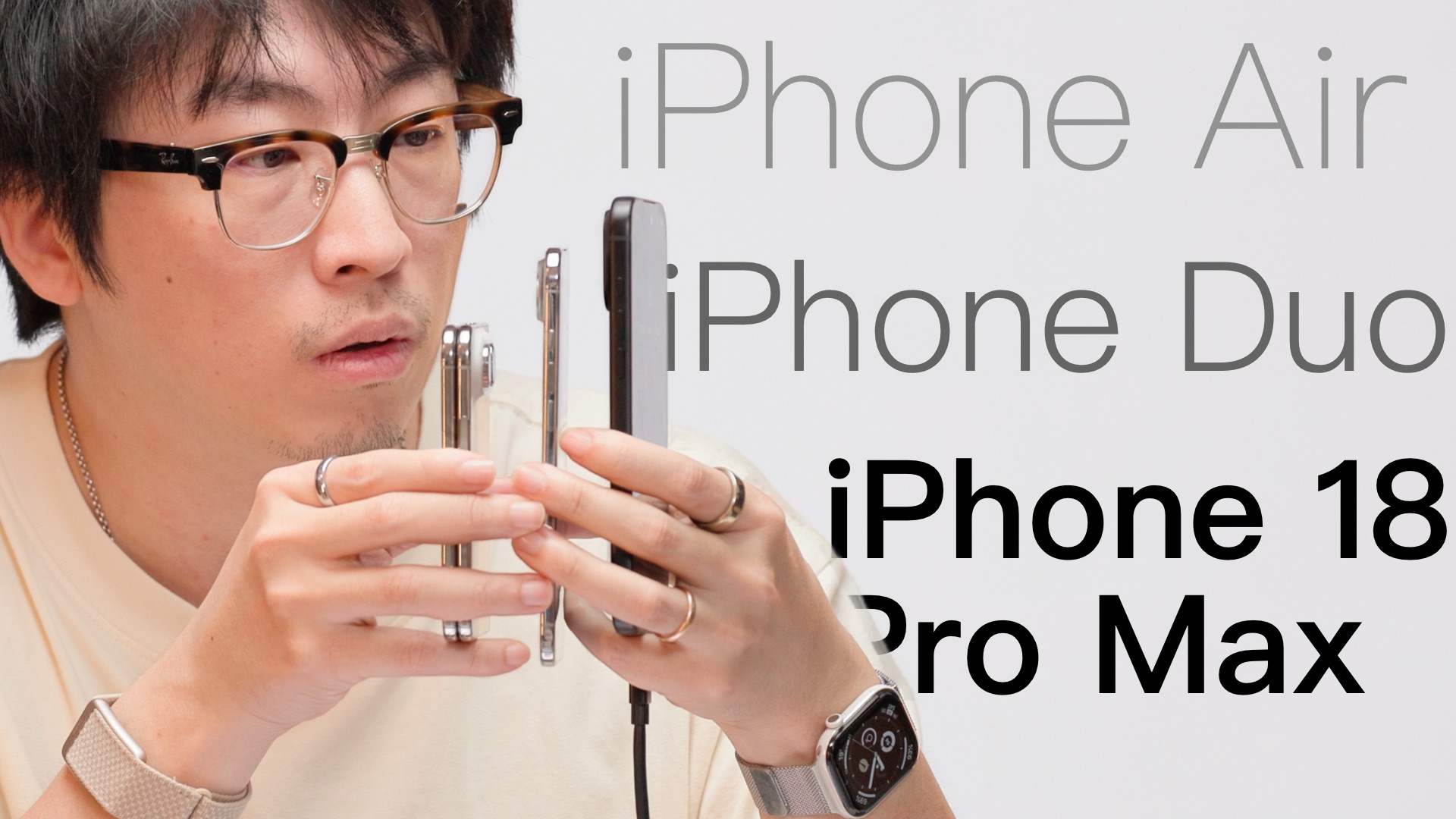
I'm heading out for a two- or three-day short business trip, so it's a good time to talk about what I bring with me when I travel these days. First, this time I brought three phones — I'll chat with you on the road about why. The one in my hand is the iPhone Duo, and the one currently filming is the iPhone 18 Pro Max. The 18 Pro Max's imaging is still better. That's my filming setup: I'm using an Acasis mount, and this mount can also hold an SSD, so the phone's footage can be recorded directly to the SSD. This is my iPhone Air, which I've used for almost a year.
It still feels the best in the hand, but in terms of imaging capability and long-duration battery stability, the 18 Pro Max wins. For example, right now I'm using the front camera, but I have to hold it far away to see myself. With the iPhone Duo, using its wide-angle lens, I can see myself in this folded form. Otherwise, with the 18 Pro Max, I'd have to use the front camera to see myself on the screen. These are for driving: a limited-edition pair of Ray-Bans. These sunglasses come with polarized lenses, and I also brought a Clubmaster.
This is probably my everyday pair of glasses. For this trip, I brought the Li Auto glasses — the ones I'm wearing now are the Li Auto ones, because they make controlling the car more convenient. There's also another Acasis device that can be used to connect to an iPhone and record video to the SSD. This is a docking station. It has an HDMI output port, USB-A, plus TF card and SD card slots, and a 10G connection. Inside, I've installed a roughly 1TB SSD, so I plan to use this trip — since the car will mostly drive itself — to chat with you all during the many hours I'll have in the car.
This is the XREAL Aura, the first unit in the country. Since this trip involves mobile work needs, I brought a laptop that can connect to the Aura, and I also brought the URXR. The URXR glasses have a wider angle — a 90-degree field of view — so with these two devices, I may also test during this trip, in the mobile work scenario, which one is more practical and gives a better experience. There's also the Xiaomi (Jimi) band — it has become something I wear every day. I've been wearing it for a month now, and it's rare that after a month I still have such great passion for a product. Every day I look forward to the report it generates about the previous day.
There's also the Shimeng photo album. I carry a Peak Design bag with me. Since I still need to test the Aura and the URXR glasses I just mentioned, I brought a game console — the Steam Deck. Oh, and by the way, let me tell you: starting around November-December this year, the XR category is seeing another wave of explosive growth. Let me go through who's involved. There's URXR, the product I'm going to be a distributor for, and there's this one from XREAL, which can only be bought overseas. I don't know if there's any channel or way to get it — we'd also like to help sell XREAL's product in China.
In December there's also PICO's Space Pro, and early next year there's Meta's VR Glasses. You can count it up yourself: these big companies — PICO and Meta, plus Google — are all releasing new hardware, and there's also URXR made by a startup. So I think in the next two or three months, there should be another small explosion of XR products. OK, let's hit the road. Since Apple released the 17 series last year — the iPhone Air also launched at that time — this phone is the one I've used the longest, almost a year now.
A while ago I got the 18 Pro Max, and I found that its imaging capability, within the Pro and Pro Max series, has become increasingly prominent. So I think the so-called "Pro" may be pointing more toward the prosumer market — that is, people who use their phones to record and shoot lots of video, and who need strong battery life and strong heat dissipation. So, prosumer. I'm a creator who mainly shoots content with professional equipment in fixed settings, so I feel the 18 Pro Max isn't very useful for me.
After buying it, the Air is still my main phone. Even after the 18 Pro Max came out, the Air remains my long-term daily driver. It was only after the iPhone Duo went on sale that I found the Duo might be more fun, which made me want to talk about my experience using the Air over the past year or so. Even now, the Air still gives me the feeling that every second it's in my hand, it's worth it. Its greatest value is that it makes you want to pick it up and use it. I feel that among all the iPhones over all these years, only the iPhone 4 and the iPhone 6 generation gave me that feeling —
the 6 because of the Plus, the bigger version. This iPhone Air, I feel, is the phone over the past five or six years — when every update was routine, with phone cameras getting stronger and stronger, and the slab phones being the Pro and Pro Max — that has satisfied me the most and felt the most comfortable in the hand in maybe ten years. You see, I even laser-removed the back cover. There was originally a heat-dissipation layer on the back — a graphene film — to make the heat distribute relatively evenly. For looks, and for fun, after making the back shell transparent,
I removed that heat-dissipation film too. The cost was actually quite significant. What does it cause? The iPhone Air already charges slower than the Pro and Pro Max, and after removing the graphene, its charging power can hardly stay at a very high level — it usually drops right away at just over ten-something to twenty watts. With that heat-dissipation film, it could maintain high-power charging for quite a long time. I think the biggest impression the iPhone Air gives me is what I've been saying for years: as a straight-up guy, we don't need several cameras — one camera for scanning QR codes is enough.
Men generally don't take many selfies anyway, and if you want to shoot something at any time, the main camera is more than enough. The main thing is that it's light and feels great in the hand—you just want to use it. It's that simple. Simple and blunt, with no real logic behind it. But there are compromises too. A lot of people online talk about the iPhone Air's battery life—it depends on what you compare it to, right? I remember when I first got the iPhone Air, I used it for a whole day and felt it was completely sufficient. But later we saw the Pro series, including two generations—the 17 and 18 Pro and Pro Max—whose battery life is truly extraordinary. So I think it depends on the specific scenario.
I used to have a bold take: I said the iPhone Air's battery life was enough for me, and even had headroom to spare. But I found that as soon as you take it on a business trip, it's not enough. So sometimes a phone's battery life is extremely subjective—it depends on what you're doing. For example, some student friends use an iPhone Air—how long can you expect its battery to last? Students may have more free time and might play games and such, which consumes a lot of power. So over these past few years, my impression is that different iPhone models are targeting increasingly distinct market segments. Take the iPhone Air—I've noticed a phenomenon:
Among my circle of friends, including some who run businesses and some with relatively flexible schedules, after the iPhone Air launched, almost 90% or more of these friends use the iPhone Air as their primary phone. But in previous years, the friends who cared most about battery life and sustained performance still needed the Pro and Pro Max to meet their needs. Although the iPhone Air uses the most flagship processor, it does have one performance core cut—one GPU core, right? And there's also its performance output.
Especially in gaming scenarios, what's actually more stable is still the Pro and Pro Max—especially this year's 18 Pro and Pro Max, which come with a large vapor chamber. I remember the 17 Pro Max had a VC vapor chamber, while the 17 Pro, I believe, didn't—I don't remember clearly. But with the 18 generation, both the Pro and Pro Max come with large VC vapor chambers. I've also tested them for a while—for example, playing games that are really power-hungry or demand a lot from the graphics—both the 18 Pro and Pro Max can sustain their performance output.
They can maintain high frame rates and screen brightness for a very, very long time, and their battery life is also extremely strong. So the Air is still genuinely my favorite phone, because I don't have those use cases—I don't do long recording sessions or play games for extended periods. As for battery life, why do I say it's enough for me? Because I've found that when I'm not traveling for work, I barely go out, and when I do go out, there's MagSafe, right? I just mount it in the car. So battery life really isn't a problem for me. But there have indeed been a few business trips where I found I needed to bring a power bank. There's also one thing I want to complain about: the official ultra-thin wireless charging battery made specifically for the iPhone Air
is completely useless. Once connected, sometimes the charging speed can't even keep up with the battery drain, and it also generates quite a lot of heat. So I think that's a real drawback. Other than that, I think if you find your own use case—if you travel frequently for work, or have especially high demands for battery life—I think the Pro and Pro Max series have further established their irreplaceability among all the iPhone models: battery life combined with sustained performance output. One more thing—the phone I use for recording video right now is the Pro Max. I've also encountered another scenario: occasionally when traveling for work,
I can't possibly bring two or three cinema cameras with me, but I will choose to bring two or three phones. The primary shooting device is definitely the Pro Max. Especially with my habit: I attach an Acasis external SSD, and once it's connected, the camera can record footage directly to the external SSD. At the same time, you can enable the highest-spec ProRes and shoot in Apple's RAW format. The image quality is actually quite good. I've tested it myself—with good lighting, its image quality is extremely strong, basically approaching a semi-professional workflow. But in low-light environments, if you don't have well-controlled lighting,
such as high-power film lights, it still falls a bit short, even if you're shooting in ProRes RAW. But I'd say if you're going for portability—for example, if you travel frequently for work and often need to shoot a lot of content—I think the Air still isn't enough. In this scenario, only the Pro and Pro Max can deliver. Then there's the VC vapor chamber—I have to talk about the vapor chambers in the 18 Pro and Pro Max. The experience is fantastic. With phones in the past, you'd notice localized heat—for example, where the processor sits on the motherboard, the heat would be very noticeable.
But with this generation's 18 Pro Max, basically the entire body is just warm—there's no longer any spot that gets scorching hot. So I think this generation's heat conduction, along with its heat dissipation—the entire heat exhaust and cooling system—represents almost a cliff-like improvement compared to previous models. Finally, having covered these two experiences, let me talk about the Duo. How should I put it? I really, really, really love the Duo, because it has given many apps special use cases. For example, in its unfolded form, it has a Hall sensor—or rather, sensors built into the hinge—
so it knows its own opening angle, and through the corresponding APIs, many developers can build really interesting things. Also, I've discovered something that confirms an idea I had: even before using the Duo, I felt that since they made a foldable iPhone, my main use case would definitely be using it unfolded. And sure enough, over these past few weeks of use, I almost never use the cover screen—very, very rarely. I've basically developed muscle memory: I pick it up, unfold it, and start using it. I've now found that Touch ID unlocking is relatively slow, so I've set it to unlock with my Apple Watch.
Basically, you just unfold it and pull up, and it unlocks automatically—faster than Touch ID in most cases. Let me share an experience with you. Because my photo library from the past twenty-plus years is all on iCloud, I have tens of thousands of photos. I've often been frustrated by junk shots that take a lot of time to deal with, but sitting at a computer deleting them one by one feels very inefficient, since I usually only have fragmented bits of time. Whether on the Air or the 18 Pro Max, I used to be quite reluctant to open the photo library and scan through it shot by shot. But on the Duo, I've been cleaning up old photos quite frequently lately.
I downloaded an app called Linger, which randomly pulls a few dozen photos from your library for you to delete. In this unfolded form, first of all, your field of view is bigger, so you can see more detail in photos—including some shots that, on the Air or the 18 Pro Max, you'd have to zoom in on to know whether they turned out well or whether they're out of focus. On the iPhone Duo, you don't have to. And what other experiences are there? I've genuinely come to prefer watching videos on the Duo, and consuming content in general. A bigger screen really is the hard truth—no experience on a handheld device can compare with a large screen.
You can't carry an iPad mini with you every day. Its folded form, I think, fits in a pocket just right, and unfolded it gives you something like an iPad mini experience—whether you're looking at photos, watching videos, or consuming content. I have another observation: typing is more comfortable, because of how it sits in your hands. In the unfolded form, using the split keyboard or the full keyboard—including in portrait orientation, or with it half-folded—gives me a feeling like playing a handheld game console back in the day. My experience with the iPhone Duo is that its overall usability, including typing and content consumption, feels really good in the hand.
But there's one bit of friction: the extra step of unfolding it. I think you just have to adapt and get used to that. But usually, once I think to unfold the phone, the next few minutes—five or ten minutes—become a very efficient and enjoyable content-consumption experience, and I think that's worth it. So recently I've adapted to this unfolded form. Coming back to the earlier point, if you insist on measuring it—right now the iPhone doesn't show this stat, that is, usage time on the outer screen versus the inner unfolded screen—but based on my own feeling, it might be 95 to 5: 95% of the time I use it unfolded.
I almost never look at the outer screen. Even when I just want to check a message, I habitually unfold it. Honestly, I find the outer screen a bit small—somewhat like the iPhone mini from years ago. I was never an iPhone mini user, so that screen is almost useless to me. Next is another point of major online controversy: the outer screen has a glossy finish, while the inner screen, as you can see, has a paper-like, matte film. At certain specific angles, you can see some whitening effect, but in my view, to the naked eye it's not as pronounced as it looks on camera.
In fact, with that glossy screen, you can see this kind of reflection—I actually think it's, to some extent, less usable. The sun happens to be out right now; take a look. And honestly speaking, I have three main displays at my company: one Pro Display XDR and two Studio Displays. Actually, I have four displays—three Studio Displays, one of which is glossy. My three main displays—because I'm currently using a MacBook Pro, which only allows three external displays—all have Nano-texture.
I've grown used to nano-texture. Over all these years I've seen plenty of online controversies—every time a new product comes out or some social event happens, two camps emerge to argue. I think many people, from surfing the web too much, have lost the ability to make independent judgments and weigh pros and cons from their own perspective. I find it rather helpless-making. As far as my personal experience goes, when I see videos online shot at a particularly extreme angle where the whole screen washes out white, I also think that experience looks bad. But actual use isn't like that, because people are flexible—if you tilt the angle a bit, that washed-out feeling can disappear.
On the contrary, I think the nano-texture has a certain premium feel. Of course, in terms of absolute clarity, if you insist on pursuing screen contrast and pixel fineness, glossy is definitely better, because glossy has no treatment applied, so its precision is certainly the highest. I think this is very subjective, because sometimes if there's a point light source behind you, I actually think that's a bigger problem. Or put another way: if, many years ago—ten or twenty years ago, when smartphones first arrived—the mainstream had been paper-like or matte screens, then if a glossy screen appeared now, I believe a bunch of people would complain about it too.
Look, there's a reflection behind—the sun is glaring so much you can't see the screen at all. I think this is just a matter of adapting to a habit; there's nothing more to say. Another point: recently I've seen a lot of people talking about the hinge issue. I've read a lot about it, and I do believe there is genuinely a batch of devices with hardware problems, including some people I know personally who've encountered it: at a certain spot on the hinge—roughly at this position—it cracks and breaks, causing damage to the screen's flex cable or to a certain area of the screen. This situation does exist. So I think if you run into this problem, just get it replaced—there's nothing else you can do. This isn't me shilling for Apple or anything like that.
But I have two Duos myself, one Hong Kong version and one mainland China version, and neither has had any problems so far. Nor have the people around me who upgraded at the same time. So I think with hardware—especially a first-generation product—if there are some manufacturing or other issues, you just get it repaired or exchanged. But overall, I think the experience is quite good. As for the iPhone's hinge, from my impression—I've also used some Android foldables—they put a lot of thought into the hinge. If you tear one down, you'll find that a whole row of the internals is hinge structure, so the feel of how it springs open is hard to describe. If you're interested, go try one in person.
Its feel is very unique. When it's about to close, there's a sense of acceleration—it automatically snaps shut for you, in that final segment, right here as it closes. Then when you open it, it pops open a little. Apply a bit of force and it opens to a slight angle; unfold it further and it moves very easily. When it's almost fully open, that's when you need to apply force again, and right at the end, as it flattens out, there's another snap. So there are roughly three or four, four or five distinct stages of tactile feedback, each corresponding to a different form. Apple must have put some thought into this, putting real effort into the R&D. The whole experience feels very Apple. Why? Why create multiple stages with different levels of resistance?
Because it has sensors—it needs to know at which angle it can stand up and hold its position. Some earlier foldable phones may not have had recognition of unfolding angle changes, but the iPhone does. There are certain apps, specific use cases, where you're meant to use it like this, or like this, or propped up. So it has to have these multi-stage changes. These little touches are done in a very Apple way. I think the next generation of the iPhone fold—the Duo, if there is a next generation—should still find ways to reduce weight in the hinge, because this generation, this weight, I really do find a bit heavy. Actually, given the Duo's relatively thick form factor,
plus this case—oh right, this case is practically a must-buy, for no other reason than that the bare device is too slippery and easy to drop, and when it's unfolded, there's nowhere to grip it with your fingers. Honestly speaking, of course the bare device feels wonderful to the touch—once unfolded, it's even thinner than the iPhone Air, which is a huge plus. But you'd worry about scratches, dropping it, or not holding it securely. I think the official case is almost a no-brainer purchase. Third-party cases might be better—over time, some thoughtful manufacturers may make a case with an even better experience—but I think at launch, the official case is the best one you can buy.
With the case, it's about 270 to 280 grams. So for the next generation, I think the hinge is one place where weight could be saved. You can see there's a small vapor chamber (VC) on it now—that part can't be slimmed down. A big reason is the added battery. Its battery should now be around 20 watt-hours, but because it has more screens and bigger screens, its battery life isn't as good as the Pro Max's, though it's much better than the Air's. Let me think—is there anything else about the iPhone Duo recently? Let's talk about the software experience, and the overall app adaptation. The iPhone Duo is, in all my years in the Apple ecosystem, the slowest-adapted generation I've used. There have been similar situations before, though—for example, with the iPhone 6, when the 6 Plus came out, many apps couldn't fill the full screen, and adaptation may have taken a month or two, two or three months. The Duo has brought back that feeling I had with the iPhone 6 and 6 Plus. Right now there are many apps—including mobile games I play from time to time, one I've played for over a decade called Clash of Clans. In the past, whenever new hardware came out, Clash of Clans would adapt within a week or two, but now it's been three or four weeks and Clash of Clans still hasn't adapted.
But let me make a bold claim: I think short-term adaptation and long-term adaptation will feel like two different things. For example, the ones that adapted right away include WeChat, Xiaohongshu, and Weibo. But if you stretch the timeline—looking at it over three months, six months—I think these app developers, like WeChat and Xiaohongshu, the people doing R&D will come up with new features, new capabilities, new ways of using it, and clever ideas. In the coming months, beyond the full-screen adaptation that's already been done in the short term, over time I think they'll have many more new tricks. That's exactly why I like the Duo so much—it has replaced the Air as my daily driver,
because it gives me more playability. When you pick up the phone and experience these apps, there's more novelty, and you can find your own inspiration. Recently I've even been thinking—should I use Claude or ChatGPT to do some app development? Because lately I've been trying out various smart glasses, that is, XR glasses. Which ones? Including the Swan that PICO is about to release—its official name is Space Pro—plus the URXR I represent, the Meta VR Glasses, and the Aura that XREAL released
in collaboration with Google. Without exception, all of these support one mode: connecting to a phone and displaying the phone's screen on your glasses. You can pretty much say that XR-type devices will see another small boom in the short term by the end of this year. So I'm also imagining: with such an elegant form factor as the iPhone Duo, connected to an external screen—could the bottom serve as a keyboard, the top have some shortcut buttons, while you have a huge display in front of you? This feeling of a half-folded computer, plus an extended screen—wouldn't that make the mobile office experience even better? Especially combined with concepts that have been very hot over the past year or two,
like Vibe Coding and AI Agents—a lot of work no longer requires precise input from us. What we need more is language output. With a big screen to view the results, give it some feedback, and let it keep working for you in the cloud or on the backend. So I don't think it's necessarily like people imagine—having to connect a mouse and keyboard and type and make spreadsheets the traditional way. Nowadays it's mainly about talking. So I think this form factor is actually better suited to today's portable screens or glasses-based extended displays, because they can give you better efficiency—letting you view results produced by many Agents at once, while having voice input,
or a very simple, very efficient input method, to control and configure all kinds of Agents. I think that's what makes this form factor fun. Over the next year or two, products with this form factor—phones with long battery life, efficient foldable screens, one external screen, and a pair of glasses—might genuinely boost many people's productivity. At least that's the case for me. Look, on this trip, I didn't bring those bulky things I used to carry. One phone plus a pair of smart display glasses—just about one little box, tossed into the bag—and in many cases there's no need to bring a laptop. But this time I did bring a laptop, because I need to test how those glasses perform with a computer.
This is part of my job, so I feel that this new form factor of the iPhone Duo has given me a lot to think about. It has given me the urge to proactively do development and explore interesting things. Many friends around me, including product managers and people who can't write code, have recently been developing on it too. So I think this form factor is really, really interesting.
There's also a big controversy online about the so-called outer layer. Many people think this layer is like—many people had this misunderstanding at first—but essentially it's just a surface layer. You can think of this layer as a film.
But I've watched a lot, including my own experience over these past few weeks and some reactions from domestic media, and I've seen all kinds of opinions. There's a guy called something like Yang Changshun—I think he was the first to say it—saying this is just a film, and once you peel it off it's the same as everything else. I think different audiences will accept different content. That's my core point. If you're willing to believe it has no technical substance, that it's just a featureless film that anyone could make—if you're willing to believe that, then I believe you won't come across my content anyway. It goes both ways.
At the iPhone Duo launch event, Johny Srouji made it very clear: it is a polymer. This polymer has very high hardness, and using something like an engraving process, they've carved out grooves, or carved out tiny lenses. In my view, it genuinely solves several problems. First of all, previously if you put a paper-like film or a matte film on a phone, it would have rainbow patterns—very fine rainbow speckles that look greenish or bluish, greenish or reddish. But on the iPhone Duo there's none of that at all. So from a process standpoint—light is an electromagnetic wave, after all—through its grooves and lens-like structures, I think they've done something to suppress that.
That's technical substance. Also, the depth between each groove is deeper, which means the light-focusing effect, or rather the color reproduction effect, should theoretically be better. But there's also a downside: at the microscopic scale, if the grooves of each tiny lens are very deep, one problem is that it easily traps oil and grease. This is actually quite amazing, folks, let me tell you. When three of us—me and two friends—went to Hong Kong to pick up this Hong Kong version of the iPhone Duo, we deliberately left lots of fingerprints on it. After getting the device, it was amazing: I brought the nano cloth we sell, and it really couldn't wipe it clean.
But with Apple's expensive cloth that sells for 69 yuan, one wipe and it was clean. I don't know why—I'll research the principle when I get back. I think that cloth probably has a corresponding treatment as well; for example, the nap might be able to reach deeper into the grooves and pull the oil out. I think there is such a process. But as I said, this film has benefits: its color reproduction is good, and there are no strange bright spots. The downside is that you need a special cloth to wipe and clean it.
Back to what I said earlier: some guy peeled it off and found that it's essentially just a film, no different. From the very beginning when we watched the launch event, including my breakdown for you all, it is a polymer. Even the original launch video said it has 10 or 11 layers, and each layer can be considered a special material. So what does peeling off this layer prove? I don't understand why, recently, the online discussion has turned into "Apple's solution for creases on foldable screens is just sticking on a film." What about its hardness? Its scratch resistance? Its color reproduction? These are all technology, all things with real technical substance.
One more thing I want to mention. I had this complaint early on too—old Steve's line, "Who wants a stylus?" That was more than a decade ago, or is it 20 years now, right? I also urgently bought a stylus—it had to be one with a USB-C connection to work. And that's also related to this film, because the hardness of this film has increased, so the experience of using the Apple Pencil is better. It's similar to the feeling of a paper-like film on an iPad Pro, and you don't have to worry much about scratching this film, because in terms of Mohs hardness, this film is harder than the tip of the Apple Pencil.
If you only look at one side of the story and say it's just a film with no difference, in reality there's a lot of know-how and technology in it. I think that's why I said earlier that different online content has different audiences. Those who oversimplify and think it's just a film probably won't come across my content anyway. Even if my content were made for them, they wouldn't have the patience to finish it. Content, creators, and audiences all choose each other—that's just how it is. What I've always talked about with you all is that Apple is a technology company, and its meticulous refinement of details in many products shows real skill. Otherwise, it wouldn't have made so many people loyal fans of the company for so many years.
Seeing a lot of recent news, and combining it with my own experience—this time I happen to be on a short three-to-four-day trip, so let's chat in the car. Over the next few days, this video will also include camera comparisons of the three phones and comparisons in different usage scenarios, which I'll weave into this video. That's it for now on the experience differences between these three phones.
OK, what I'm wearing now is the Aura from XREAL's collaboration with Google. This device will go on sale around next week. Over the past few months I've found that the iPhone Air doesn't have DP video output, meaning the iPhone Air can't connect with a cable to the Aura, but both the Pro Max and the iPhone Duo can. You'll be able to see this in the B-roll—this is the Duo's screen casting. It can natively receive a 1920×1080 60 Hz signal; it can't go any higher. But if you hold it a bit farther away, you can barely make out pixels and subpixels, so I think it's fine. For temporary use, like on a business trip, this kind of screen casting works well. The Air can't do it. So that's why I've always felt...
The Air made a lot of compromises it shouldn't have. I'm currently using the Pro Max to shoot A-roll footage—take a look. This is my current solution for recording long A-roll takes with the Pro Max. With an external SSD attached, it can record ProRes format at up to 4K 120 fps. This is why I've always felt that among these three phones—Air used to be my main phone, but now I've found that many features just aren't available. Its only advantage now is that it feels really comfortable to hold; the in-hand feel is great and it's very satisfying.
But if you're traveling on business, for example, and want to record the best possible footage, features like DP video output are all missing. The iPhone Duo's features are relatively complete, but it falls short on battery life and top-spec recording. So have you noticed what Apple is doing? At this year's event, if you remember, they said that going forward, especially in the US, when using the Verizon and T-Mobile carriers, if you own multiple iPhones, you can switch your phone number to any of them.
Then, based on your needs, you can take whichever phone you need when you go out. In the past, for single-phone users in the Apple ecosystem like us, one phone might have been enough, but going forward it may not meet my needs. So now it's awkward: the iPhone Air, although I love its feel the most and it's the lightest to hold, has slightly worse battery life than the Duo and the Pro Max. On the imaging side, it only has a single camera, no ProRes-level recording, and no DP video output. The Pro Max series has always had the strongest imaging. For example, this long A-roll take I'm recording now can be done through an external box.
Let me show you. This is the Arcassis setup I use—it has a mount plus an external SSD acting as a dock. With this mount attached, the Pro Max can record at 4K, even up to 60 fps and 120 fps, using Apple Log and RAW formats. This gives you more freedom in post-production color grading, and theoretically the best image quality. What's my own experience? If you use the main camera of the iPhone Air, the Duo, or the 18 Pro Max to shoot Rec.709,
or already color-graded HEVC footage, the difference in image quality isn't that big. In particular, it doesn't showcase the Pro Max series' large-aperture and controllable-aperture system—on the surface, the image quality looks pretty similar. But especially when natural light is good, or when you have controllable lighting, if you shoot with the 18 Pro Max's Apple RAW using a Log format and do some color grading in post, you get greater dynamic range and better results. If you need to do some mobile work on the go while driving, the glasses I'm wearing right now are the URXR,
which, as I mentioned earlier, is a product with a standout advantage in extended display and screen mirroring capabilities. Once it's connected to a computer, let me show you—I have this cable plugged into my computer, running all the way to these glasses. The image I'm seeing right now is at least 70 to 80 inches, and I can enlarge it further because it has multiple adjustable levels. The screen I'm looking at right now is the one attached to the Li Auto—if I remember correctly, it should be about 21 inches, roughly a 21-inch screen. This entertainment screen actually covers a lot of needs for watching movies or temporarily mirroring a screen for work. But the field of view provided by the URXR glasses
allows the screen size to reach 70 to 80 inches or even larger—even over a hundred inches is no problem. And because it also has a spatial tracking chip, in theory, when you enable something like Travel Mode or Space Anchor, the screen stays firmly fixed in the car's space. You can think of it as Vision Pro's Travel Mode. Let me show you—through my screen-recording setup you can see that I'm currently using Travel Mode. This screen is roughly equivalent to 70 to 80 inches, and I can make it bigger. Its position in space is already fixed,
and it basically doesn't drift around. The Aura can also achieve this kind of functionality. Essentially, you can think of the Aura as a relatively lightweight, glasses-shaped Vision Pro. It's a spatial computing device—the only question is what trade-offs it made. It leverages its portability and lightness, which are its strengths, but sacrifices a certain degree of computing performance and FOV. The Vision Pro has a field of view of about 100 to 110 degrees, while the Aura has roughly a 70-degree diagonal field of view. So in this kind of scenario,
the Aura can of course also serve as a mobile work screen and meet this need. But in terms of screen mirroring capability, it can only accept a 1920×1080 signal at 60 fps. The URXR can do 2560×1440 at 90 Hz—a 90 fps video signal. So that's one difference. In other words, as I keep saying, the Aura is an all-rounder—it can basically do everything. But if you want the best screen mirroring experience, or the best extended-display experience, I personally think the URXR still has the advantage. Now let me show you the view through the Aura's screen mirroring.
Because the Aura's system is now quite mature, it has even fully implemented the recording part—the built-in screen-recording function. I can record it and show you. I've now enabled, through the Aura, a field of view roughly the same size as the URXR just now—about 80 inches or even larger. But as I mentioned earlier, if you shake your head, the screen basically gets cropped. Seventy degrees sounds like a good number for a diagonal FOV, but compared to devices with a larger field of view, you can still see some differences. So in this situation, using the Aura
You should shrink the screen a bit, to roughly this size. From where I'm sitting now, it looks like about a 50-inch screen. At that size, you basically avoid the problem of the screen getting easily cropped out of view when you move your head. But compared to the URXR, I'll say it again: the Aura really is a spatial computer. Even in terms of control, you can use the touchpad like a mouse, and that experience is actually quite good. In a bumpy travel environment, if you want to control the screen with hand gestures—since the Aura doesn't have eye tracking—using your hands is very difficult. My hand keeps shaking here, and I can't grab the thing I want to tap. But with the touchpad, you can achieve relatively precise operations.
As you can see, if I need to drag this screen frame, I can do it in a way similar to clicking a mouse, allowing fairly precise control. For example, adjusting the screen size again—grab it and pull it back. See, now my window is smaller. At the same time, I can also use gestures to operate other apps. For instance, I can place multiple screens, and there's even Google's Gemini, a native AI. It can also natively run video apps like YouTube. Since I'm not connected to the internet right now, I can do this in the car—so in theory, in travel or business trip scenarios, you get the experience of having multiple spatial screens. The URXR can achieve this too, with a larger field of view at the same time. But again, there's no way to record the screen right now—I can only film it with my phone. So I'll probably have to wait until the beta tool for Mac is handed to me before I can give everyone a more complete experience.
For now, though, my view remains the same: a 90-degree FOV still has a considerable advantage over 70 degrees. Even though the Aura is such a comprehensive flagship Android XR device, I don't think 70 degrees is the sweet spot. The real sweet spot has to be 80 to 90 degrees.
In any case, personally, whether it's connecting a computer or a phone during business trips—those temporary office or work scenarios—what I foresee is that the iPhone Duo and MacBook Pro will be the devices I connect as extended screens when traveling. Since the Pro Max is mainly used for shooting, and the Air doesn't have this output capability, that's one reason why the iPhone Duo is inevitably my main phone right now.