
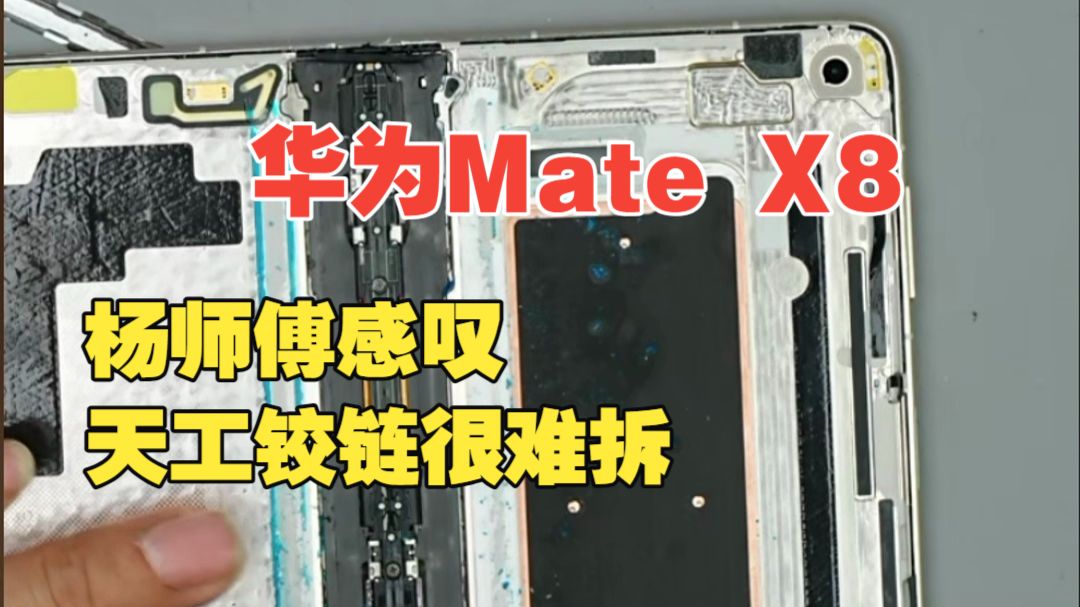
It's not like it really can't be removed, right? Is the skill not up to par? Skill not up to par—if it can't be removed, I'm stumped. Can't be removed. Let me first confirm—I'll first confirm whether these are two magnetic strips. Confirmed, the ones shown at the launch event are these two strips, the raised part attracting downward. The blade is stuck on. If the blade weren't stuck, it would slide. This side is the overlapping magnetic part, and this side is the two-strip section. But I want to see the structure—I want to see the structure. Can't be removed, can't be removed. Should we keep trying to remove it or just not look? It's these two strips on this side. Those of you who just entered the livestream room, hurry up and interact. Masters who haven't followed me yet, give me a follow.
If you pry it like this, it will definitely break. Prying it like this will definitely break it. Wow, it's so thin, so thin. If this is a magnet, then it's made extremely, extremely thin. But it can't be removed. If it can't be removed, then I need to take apart this and this. Looks like I need to separate this metal part here. Right here, let me try this spot first. Otherwise, if there's metal here at this spot, it doesn't quite make sense. Give me a little time. There's glue here—this is glue. Forget it, we won't take it apart this way. Not taking it apart this way. Can't be removed, can't be removed. Then let's first remove the screws in the middle. Look carefully at the hinge area first.
The hinge. Okay, not many screws—not many screws. I'll remove them quickly. But now that I've disassembled it to this point, I can't show everyone how excellent the screen crease control is, because it can't be seen anymore. Now we can only look at its structure. Those who were here when I first entered the livestream room saw it. Come on, rate the crease control from 1 to 10—what score do you give? Let's interact in the livestream room first. You interact first while I guess. This should be the strip at the back. Can it be taken off now? Normally, even if you pull this strip out, it still won't work. Still won't work. Can't see it. What we're seeing now of this craftsmanship is only the surface.
A lot of things are blocked and invisible. If I take all of this apart, then you'll really see what modern craftsmanship is like combined together. But right now we can't see it—we really can't see it now, because I can't guess this structure. Now this is funny, right? I feel like there are screws at the back again. Seems like there are screws. Okay, these here are waterproof screws—over here. Look, no screws on this side; they've all been sealed with waterproof glue. This side is hard to take apart. Is the difficulty really this high? When I took apart Apple products back then, I never found them made this precise. You just look with your eyes and casually pick at it with your hands.
It's all taken apart now. There should still be some structural detail somewhere that I overlooked. This side here—seems like something on the reverse side is holding it. Okay, now we can only remove the screws. We can only remove this row of screws on both sides. Uh, did someone just send a power chip? OK, thanks to Bald Brother. After opening this side, we should still be able to see the structure clearly. And later this phone can still be reassembled. Ah, after taking this off, it's very flat—the screen is very flat after removal. The screen's base is good too. With a normal foldable phone, once we take the screen off, it gets all wrinkled and crumpled by us—
like a folded A4 sheet, like a crumpled A4 paper that's been flattened out. But this screen, after I just removed it, still looks very flat and very clear. So this time the X8 must have been improved in many areas. Masters who haven't followed me yet, give me a follow. Follow me so you don't miss the teardowns of these new phones. Teardowns. There are 5,000 people in the livestream room—how many of you have already followed me? Type "followed" if you have; type "not followed" if you haven't yet. A couple of days ago I bought that Apple touchscreen laptop, originally planning to tear it down, but things got delayed.
It's been sitting there, and now the 16TB storage expansion is almost done. When it's ready, I'll just release it as a video. Okay, done. Take off the whole strip—take off the whole strip. There's still one screw here, right? Here—here's another screw. I refuse to believe I can't see it today. From the current situation, we can definitely see it. Great force works miracles. No, no, no—just kidding. You go buy one, and I'll use great force to work miracles. Seriously—you buy one, I'll do the "great force miracles" thing, and streaming on your account, that one stream would gain quite a few followers. Really, open up your horizons. How many people want to stream on their account?
They provide the phone—are there any sneaky ones in the livestream room? For future new phone teardowns, you pay for the purchase, and I do the teardown stream for fun, we get to understand the structure, and we stream on your account. Anyone want to participate? If you want to participate, type "participate" to sign up. Sign up directly. Boss Ma wants to join too? Stop bragging. Do I not know what Boss Ma is like—is this my first day knowing him? If you picked any random person, I could believe you, but saying Yuecheng Boss Ma—impossible. He'd haggle forever over one or two yuan. That's a joke. This piece seems like it still can't be removed. Oh, it can be removed, it can be removed.
There's glue here, because it's made waterproof now. A foldable phone that's waterproof means its structural requirements are extremely, extremely complex. Here's where the glue is applied, because on top of this spot there's a piece covering this flex cable, and here at the hinge, water absolutely cannot be allowed to seep in. It's also waterproofed. If we don't take out the flex cable, we can't show everyone this entire middle hinge. So let me remove this first. Heating it up will make removal faster—when it's hot, the glue softens. Once the glue softens, then—holy crap, Boss Ma, I broke your flex cable while removing it.
He should compensate me for one. Okay, there's still this here. In a moment we can take out the whole thing—the whole thing can come out. OK, is this teardown satisfying enough? Okay, this part is removed—satisfying enough. Everything can be taken off with the big pieces. All the structure can now be seen. Seems like I've never torn down anything this finely before, right? This teardown was detailed enough—type "detailed enough" if you're satisfied. Type "not satisfied" if not. Okay, OK. Oh, this hinge is also made extremely, extremely thin. Wow, this hinge—no wonder it couldn't be pried off earlier. This hinge also has hidden clasps on the reverse side, all locked together.
It's really locked together — there are hidden latches. No wonder it took so long and wouldn't come off. Oh, I see. So if we want to remove those two pieces from earlier, how would we do it? What method? It's actually kind of hard to guess. My goodness, it really is hard to take apart. There are big grooves on both sides — it relies on these two sides pressing inward. Once we open it, it sucks downward. The structure is locked very tightly. It's locked together with the hinge, right? Look, it's hard to separate. This really is hard to separate. Let's look at the back. Wow, this structure is extraordinarily complex. There are connection points over here, support points in this spot, and here too, and here.
Look — springs, spring compression, the rebound force. This rebounding part requires opening the back section. It should be in this area — there are lots of springs pushing against it. Otherwise, how could the force be so strong? Look, but right now this structure is hidden — you can't see the spring mechanism. See, the needle is hidden in the back. Here — see it? Inside this part. So if we want to see the entire hinge structure, this piece has to come off. Once this is removed, the whole hinge structure will be visible. Let me first see if I can lift it off. And those of you who haven't followed yet, please give me a follow. If you haven't followed, hit that follow button.
Not many new followers, huh? How many followers? With 70,000 people in the livestream, we only gained 100 followers. Seventy thousand people and only 100 followers. End the stream, end it, end it. And I'm still taking this apart for you all to see. Come on, if you haven't followed, hit follow. Come on! Those who haven't followed, give me a follow. And if you haven't followed the top one, two, and three on the leaderboard, hurry up — follow the top one, two, and three. Is it pried this way? I keep feeling like this isn't right. From what we can see so far, it should be pried this way. Too complicated — it's made way too complicated. Made too complicated, hard to take apart, really. Hmm, this is still a bit complex.
Still a bit complex. Okay, almost done — the opening is cut. Once the opening is cut, apply heat, then run along this line, and the whole thing becomes visible. Using alcohol to soften it wasn't very effective. Here we go, we still need to heat it. But heating causes a problem — it's hot! Ow, this scalding thing burns so much, ow. Wow, this is so complex. I was wondering why I couldn't see the springs — turns out they're hidden in the back. Okay, look, isn't this structure complex? For a foldable screen, controlling the crease well is really not a simple thing. Let's look inside this hinge and see how many parts the springs here are assembled from.
Assembling this centerline section — wouldn't this take several hours of work? Okay, let's run it under the microscope. It's not very clear right now — it'll be clearer under the microscope. I finally got it open. Okay, now let's wipe it clean first. Yeah, you can close it, you can close it. Alright, let me adjust the microscope focus a bit. And this is just one set — this is just one set. Look at the side — see, on the side there's still this, hanging on the side. These two strips can be removed, but I haven't found the method yet. It's 100% removable. Probably this piece needs to come off first. Once this is removed first,
it can be taken straight out. But this structure looks a bit like it's locked on. It really does look like it's locked on. The magnet is right here, but it's hard to open it up for a look. Hard to open, hard to take apart. The structure is still a bit complex, huh. Oh, why are there two gold-colored springs here too? So how many springs are in one set? Let's count. In one set — this side has four, 4 plus 4 makes 8, eight springs. Oh, and to keep the screws from loosening after assembly, the final screws even received spot welding. I don't know if you all saw that — look, after spot welding, when you bend it, the screws can't possibly come loose.
You can't have a situation where, after using it for a while, a screw falls out or a screw loosens. Impossible — they've all been spot welded. Come look, all the screws are welded dead. That way, at the structural stress points, no matter how you bend it — see, this structure is extremely well designed. Look, when you bend it upward, this part moves inward, and the spring gets compressed inward. Much better — really far better than the foldable screen we took apart last time. Not even in the same class, truly not the same class. That one had claws gripping to both sides, and when gripping to both sides, sometimes when bending, with a bit of carelessness, a bit of force and a snap, the screen would get punctured. That was that kind of structure. But this one won't do that. And it's not just Huawei — as far as I can recall, no manufacturer's hinge has ever had a problem where bending caused the screen to be punctured. Foldables have been on sale for a long, long time now, and it seems no brand has had this issue. It seems only that one company had the problem — it really seems it was just that one company, that hinge. I really haven't seen it. Foldables have been sold for so many years, and no brand has had a hinge puncture the screen. It seems there was just one — the only one — and even Samsung came out mocking them for it.
It really is laughable. With this structure, how could you possibly break this hinge by bending it and puncture the screen? Impossible — not in this lifetime. Even if the hinge were bent to pieces, it wouldn't burst open, because look, the structure is right here — it can't escape. Anyway, honestly, in my memory, there really has never been a foldable maker whose hinge, when bent, would push up and damage the screen. Foldables have been sold for so long now, and no brand has this common flaw — it's only that one company. Alright, so our teardown basically ends here. We've taken apart and looked at everything we should.
This craftsmanship is really fine. Look at this filler section in the middle — the part where the groove isn't so deep in the middle. This is a steel plate — this is a steel plate — yet it feels warmer than paper. It really is. And inside there are five layers — that thin little bit in the middle has five layers. We saw this earlier too. As for this area — ah, we didn't look thoroughly enough earlier. And inside this steel plate there are three pieces — the middle one is the largest, and the two sides can fold. And there's glue on top. Let me peel this off and you'll be able to see it — there are three steel plates on this.
I even broke my tweezers taking it apart. And this thing is extremely, extremely thin—so thin that it's not even as thick as this double-sided tape. It's about the same thickness as double-sided tape. This was also made to solve the crease in the middle. It's very soft, really soft. This should be that "hand-tearable steel." Let me try it and see if I can tear it apart. Oh no, I can't. Wow, the toughness is excellent. The toughness is really excellent. I can't put it back together—I definitely can't put it back together, it's already been taken apart like this. I'll take this to the after-sales service to have it reassembled. If you install things like this, the screen crease will definitely end up looking ugly. I'll just pack this up tomorrow.
Are these broken parts? Buy them from after-sales service, then just install them directly. If you guys don't believe this phone can be reassembled, I'll put out another video later, okay? I'll take this mess to after-sales service, spend a bit of money, and they can put it back together for me. You're saying this is stolen from Xiaomi? That's nonsense. Bring the Xiaomi one over here. Xiaomi's crease—this crease can't compare with Xiaomi's. Where did you take it? Is this, this, this Xiaomi? No, this is Apple. This is Apple's. Apple's is because of its matte film issue—it really did control it. Do you think it works? But let me tell you,
Apple's research on the crease was really just research on a single film. As long as you peel off that film—and that film is quite brittle—there's nothing you can do. Let me peel it off and show you. Especially in this high-brightness state, look, doesn't this still look pretty okay? This flat part is fine, wow. After it's peeled off—wait, once I clean this up, this can be reattached. There's this film you can stick on. After it's peeled off, the adhesive on it is still like this, and then when you peel it, it becomes like this. See that? After peeling, it's just like this. But the X8 doesn't have this thing. The X8 doesn't have this in the middle.
It really doesn't. There's really no stolen Xiaomi technology. You're talking about Xiaomi's—look, Xiaomi's is also very obvious. See that? In the middle, when the X8 is laid flat, there's none of this—none of these wavy patterns. Really, there isn't. Really, there isn't. When it's laid open and flat, it's just flat. See that? Just like this. So the one with the best crease control so far, the one that has truly impressed me, is this X8. It really is this X8. Look at the screen—look, after taking it apart, it still looks pretty decent, right? It doesn't have that kind of uneven, bumpy appearance. Whether it's the screen's digitizer, the hinge,
the laser leveling in the middle, or all the supports used on top—all of it, all of it is good. Only then can it be this flat after opening, this flat. The XT2's hinge is the same as the X8's—oh wait, the XT2 is different. The XT2's crease differs greatly from the X8's. Should I bring both phones over and give you a final look? I'll take it down after the stream—the XT2. The XT2 doesn't use this X8 technology. The XD3 will probably use this X8 technology when it comes out. But the difference between the two of them is very, very big. Want to see it? Look, this is Apple. After Apple's film is peeled off, it's just like this, just like this.
It really is like this. This is fully transparent now. But I haven't removed the glue underneath yet. If I remove the glue, the crease will become even more obvious. That's it for this one. Oh, is this a magnet? Did I say that wrong? No—oh, this is a magnet. I think this is a magnet, I got it wrong. Never mind, never mind. I searched forever and couldn't find it. Second, look, it's also very obvious. The XT2's is also quite obvious. But the XT2 definitely doesn't use this X8 technology. With the X8's technology, you can't see any of these marks on this side. Really, there aren't any. It looks like a full screen. Didn't I bring it? It's gone, let's not look anymore, okay?
Let's not look anymore. That's it for today's teardown. I still need to pack it all up. In a bit, Nana will probably pack up all the stuff, and right now I haven't given the top-ranked fans yet—