
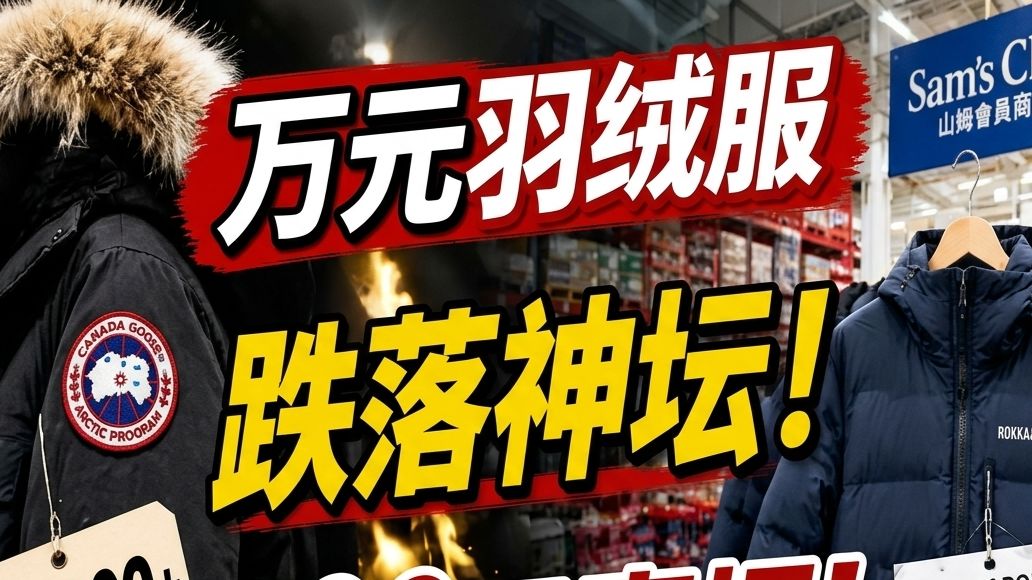
The 10,000-yuan down jacket has fallen from its pedestal, while Sam's Club sells one for 399 yuan. This generation of the middle class finally doesn't want to be fleeced anymore. These days, what's dropping faster than the temperature is the price illusion of down jackets. On one side, the once-top-tier Canada Goose has seen its revenue growth slide from 21% down to just over 1%, with financial reports getting uglier each time—even its Asia-Pacific store managers have started sighing at the empty streams of customers. On the other side, a 399-yuan long down jacket with 300 grams of fill at Sam's Club is being tossed into shopping carts by middle-class shoppers as if they were grabbing Swiss rolls, even selling out of sizes. You read that right. The middle-class consumers who once chased Canada Goose, Moncler, and Bosideng's Black Gold series are now collectively turning around and rushing to the shelves of warehouse supermarkets to snag a down jacket priced in the triple digits. Does this scene seem absurd? Not at all. Behind it lies an extremely pragmatic signal: the middle class is carrying out a collective rejection of brand premiums.
The demystification of down jackets: from face-anxiety to parameters being king. If you enjoy this channel's content, please click the little bell to follow and subscribe. Below, Dianliang Jun will walk you through it all.
The middle class no longer worships big logos, instead chasing after concrete, tangible specifications: 100% polyester shell, filled with white duck down at 80% down content, 600+ fill power, complying with the GB/T 14272-2021 down jacket standard. As a result, shopping carts at Sam's Club—once filled with Swiss rolls and bulk snacks—are now being stuffed with 399-yuan down jackets with 300 grams of fill. And this scene isn't playing out only at Sam's Club, this warehouse-style supermarket. Today's consumers are voting with their feet for a pragmatic winter.
Fought over by the middle class, Sam's Club's 399-yuan down jacket has become a hot commodity. In the past, the middle class went to Sam's Club to buy Swiss rolls, roast chicken, imported fruit, and so on; now they head straight for the down jacket section. One men's long down jacket priced at 399 yuan with a fill weight of a full 300 grams sold out completely. Many netizens remarked that down jackets nowadays easily cost over a thousand yuan each, yet here was such a cheap long down jacket. What does a fill weight of about 300 grams mean? It's enough to handle environments of minus ten to twenty degrees Celsius at the coldest—except in some high-cold regions of the Northeast and Northwest. Keep in mind that down jackets on the market with a fill weight of 300 to 400 grams typically cost over a thousand yuan, and long versions run around 2,000 yuan. And according to the brand's tag, the down content is 80%—under the new national standard implemented in 2022, this is a mark of high-quality down. The jacket also bears the international down standard label. Getting a 300-gram-fill long down jacket for under 400 yuan is truly a bargain. Last year, the same series' women's version with 400 grams of fill cost 100 yuan more; this year, the men's version reduced the fill weight and pushed the price down to 399.9 yuan, and its cost-performance instantly went viral. No wonder the middle class heads straight to the clothing section to find it as soon as they enter the store. The women's down jacket in the same series, though priced the same as last year, has also sold like hotcakes—especially in northern cities and in southern areas without central heating. At Sam's Club stores in first-tier cities and provinces such as Beijing, Shanghai, Zhejiang, and Jiangsu, both online and offline bestseller lists show many items out of stock. Some netizens have even hailed Sam's Club as the savior of the down jacket world. In an era when down jackets routinely cost four or five figures, Sam's Club's hundred-yuan-level jackets offer everyone a burden-free yet respectable value-for-money option.
In fact, Sam's Club's down jackets haven't just started being sought after this year. As early as 2023, Sam's Club was already selling down jackets, but at the time reviews mostly centered on labels like "ugly," "bulky," and "unattractive," and they made little noise in the market. It wasn't until the winter of 2025 that consumers—long stabbed in the back by high down jacket prices—realized how solid Sam's Club's down jackets were. At that point, some media outlets compiled the specifications of down jackets from eight brands including Bosideng, Camel, and FILA, and found that Sam's Club's jacket was not only the best value but also the warmest. So once people understood the parameters, it suddenly dawned on everyone: buying a down jacket isn't about the higher the price or the louder the brand being more reliable. Bulky or not, ugly or not—in the cold of winter, only warmth is what truly matters. The middle class's old consumption impulses are being replaced by pragmatism. Suddenly, everyone flooded into Sam's Club. Behind this is Sam's Club's use of a minimal SKU strategy and powerful global sourcing capabilities to directly forge the shortest path from factory to shelf, using transparent specifications to directly respond to consumers' urgent demand for genuine value at honest prices. Looking deeper, what people are buying isn't just a garment to keep out the cold, but an attitude of refusing to be held hostage by consumerism. Behind living like a practical, down-to-earth person is no longer blindly chasing big logos—letting warmth return to its essence, and letting value be re-anchored in the product itself.
Even more intriguing, this down jacket craze doesn't belong to Sam's Club alone. Pang Dong Lai's shelves—where that 626-yuan Tambr and the 599-yuan Nuan Pin Dao jackets sit—have recently also seen items snapped up several at a time. Why supermarkets? Why Pang Dong Lai and Sam's Club? Because people have been burned too many times. There are thousands upon thousands of down jacket brands on the market, each with endless marketing rhetoric—"warms up in five seconds," "polar-grade cold protection"—yet a glance at the tag shows a fill weight lighter than your own sweater. Your trust has been exhausted through repeated harvesting. At this moment, Sam's Club and Pang Dong Lai have stepped forward. Pang Dong Lai simply prints costs and down content directly on the labels, giving you a fully "naked" display. Sam's Club uses its buyer system to do the first round of screening for you, putting only products with qualified specifications on the shelves. This isn't just buying a down jacket—this is spending a few hundred yuan to buy a sense of security, without having to painstakingly compare reviews or gamble on luck. In an era when consumption decisions increasingly resemble math problems, whoever provides transparent parameters earns the endorsement of trust; whoever earns the endorsement of trust can pin internet-famous big brands to the ground.
The midlife crisis of high-end brands: the middle class isn't out of money—they just don't want to be suckers. Everyone is grabbing several at a time—not only good-looking, warm, and thick, but also high in cost-performance. After several years of hard lessons, today's consumers have become increasingly shrewd. To buy a satisfying down jacket, they've turned themselves into half-experts on specifications. Core indicators like fill weight, down content, and fill power have become must-check points, for fear of falling into traps buried in complicated marketing talk. Among them, Pang Dong Lai's approach stands out as a breath of fresh air: they plainly and clearly label the cost, profit margin, down content, fill weight, and down content percentage—no fraud, no high premiums. When buying winter clothing, many people tend to easily trust brands and influencer-endorsed items, believing that a down jacket costing over a thousand yuan can't possibly be poor quality. In fact, that's not the case—the pricing of many brand-name down jackets includes the costs of marketing, packaging, and brand premiums.
The actual cost of down raw materials doesn't account for a large share. What's more, down jacket prices have recently been trending lower. According to market data from the Down Jin Network, on November 8, the quoted price of 80% white duck down fell 6.3% year-on-year to 444.72 yuan per kilogram, sitting at a low point for the past year. On the other hand, market chaos still persists. Some merchants falsely label the down fill weight or mix in non-down filler. The jackets look fluffy and thick, but their warmth falls far short of what the price suggests—consumers end up wasting their money.
Compared with Sam's Club's 399-yuan jacket with 300 grams of down fill, which offers excellent value for money, Pang Dong Lai may not win on rock-bottom prices, but it excels in simple, understated design with few flashy elements. Its specifications are transparently labeled, and quality control is relatively stable. The hang tags clearly state the fill weight and down content, letting consumers see everything at a glance and greatly reducing the risk of getting a bad product. Pang Dong Lai's "naked" display style lets consumers see through the channel fees and marketing bubbles hidden in traditionally high prices, while Sam's Club's overwhelming specifications ensure consumers spend every cent on genuine warmth.
As consumer trust is betrayed time and again, supermarkets like Pang Dong Lai and Sam's Club undoubtedly provide consumers with a powerful channel of brand trust. What people buy here is not just a piece of clothing, but a sense of security—no need to painstakingly compare reviews or gamble on luck.
This trust doesn't come out of nowhere; it is built on extreme transparency and strict quality control. While supermarket down jackets are on the rise, the numbers on the other side also tell a story. Canada Goose's revenue growth fell from 21.54% in fiscal year 2022 to 1.1% by fiscal year 2025. In its second-quarter results for fiscal year 2027, direct-to-consumer same-store sales in the Asia-Pacific region fell about 4%. Chief Financial Officer Neil Bing said this was mainly due to reduced foot traffic, especially in mainland China. In the third quarter of 2026, Moncler brand revenue fell 1% year-on-year to 499.6 million euros, mainly affected by weakness in the DTC channel. In addition, Bosideng, which focuses on high-end down jackets, has seen store closures in multiple locations this year. In terms of performance, the brand's revenue growth dropped from 38.4% in fiscal year 2024 to single digits in fiscal year 2026.
The core customer base for ten-thousand-yuan down jackets still exists, but they now have to stretch to afford them. The group that used to buy five-figure down jackets has already drifted away. After all, truly wealthy customers don't care about price—it's the middle-class segment in between that is price-sensitive. In the past, when the middle class bought ten-thousand-yuan down jackets, they were buying brand narratives and status labels. But now, in an era when everyone is focused simply on getting by, people care more about quantifiable parameters like fill weight, down content, and fill power. After doing the math, they find the premium isn't worth it. This group increasingly values a product's actual worth: a few hundred yuan buys a down jacket with proper warmth and accurate specifications, and the money saved can go toward more experiential spending like outdoor camping or fitness. Many people's mindset has changed: they can afford it, but they no longer want to be suckers.
The middle class isn't refusing to spend money—they're refusing to be led around by marketing. They will still spend where it counts: health, experiences, hobbies, learning, and companionship—many people are still willing to pay for these. Now that consumers have awakened, the premiums propped up by logos, stories, and status are becoming harder and harder to sell. Because everyone understands: buying expensive things doesn't inherently make you more sophisticated, and buying cheap things doesn't make you cheap. A jacket costing over ten thousand yuan cannot prove who you are, and a premium brand cannot prop up genuine quality of life.
This winter, the middle class flocking to supermarkets to buy down jackets is essentially a vote of no confidence against overpriced down jackets. Through their actions, people are expressing an attitude of rational shopping rather than blindly paying for a logo. At the end of the day, when it comes to everyday life, practicality matters most when buying a down jacket. Spending money on genuine quality and real materials works far better than any marketing pitch or brand story. We'd love to hear your opinions and views—feel free to leave a comment in the section below. We look forward to your insightful comments.